


10.11.2026
Packaging for Uzum Market: How to Sell from the Screen and After Delivery

A shopper on Uzum Market only holds the packaging after they have paid. Before that, they see it on a smartphone screen, in a feed, the size of a postage stamp. Packaging designed only for a supermarket shelf loses twice here: in the feed it cannot be read, and after delivery it arrives crumpled or says nothing when it is opened. Below is what changes in packaging design when the main sales channel is a marketplace.
In short. On a marketplace, packaging sells twice: on the smartphone screen and at the moment the order is opened at home. The screen needs a front where the brand, product type, variant and size can be read at first glance. Delivery needs a sturdy structure, correct labeling and an insert that leads the shopper to a second order.
Why is packaging for Uzum a separate task?
Because on a marketplace the shopper first meets not the box but its photo, and chooses without a sales assistant. The channel is already large and growing fast. According to Uzum, e-commerce in Uzbekistan reached almost 23 trillion soums in 2025, but that is still only 5–6% of retail; the marketplace has more than 18,500 sellers and over 2 million products, and orders have reached about 50 million a year (Spot, 23.10.2026). About 90% of sellers are small businesses (Gazeta.uz, 09.07.2026).
Retail itself is growing too: in January–July 2026 retail turnover reached 310.9 trillion soums, 20.2% more than a year earlier (stat.uz, 29.08.2026). An important caveat: Uzum’s figures are the company’s own data; there are no official statistics on e-commerce volume for 2026 yet.
The practical takeaway: in Kashkadarya or Karakalpakstan, where, according to the company, the number of orders has grown 3–5 times, many shoppers meet a brand for the first time on a screen. If the packaging cannot be read there, there may be no second meeting.
What should be readable in the main product photo?
The main photo should make four things readable: brand, product type, variant and size or quantity. These are exactly the attributes GS1 names in its guidelines for mobile ready hero images (GS1 Sweden). The guidelines were developed with the University of Cambridge and Unilever. In a Unilever test, such images of Magnum ice cream increased the retailer’s sales by 24% over eight weeks (University of Cambridge, 07.02.2018).
This gives the rules for the front of the pack:
- One main word. The product type — “washing powder”, “wafers”, “shampoo” — is set large and does not compete with the logo.
- Variant through color. Flavor, scent or purpose is coded with a color that can be told apart even in a thumbnail. How color works on packaging and where the myths begin is covered in our article on color and shape psychology.
- Size on the front. The back is not visible on screen, so 400 g or 30 pieces sit on the front as a large number.
- Fewer small details. Three benefit badges, a medal and a tiny slogan merge into noise in a thumbnail. They belong in the extra shots of the product card.
A simple test: shrink the front layout to the size of a thumbnail in the mobile app and show it to someone who has not seen it. If they cannot name the product and the variant, the front needs simplifying. On a shelf the shopper has 3–5 seconds, and in the feed the packaging sits next to dozens of competitors of the same size.
Do you need separate packaging for the marketplace?
Most often you do not: it is enough for the front to be designed with the small scale in mind. A separate version is justified when the product sells mainly online, or when the front is overloaded and cannot be simplified without losses on the shelf. On a marketplace, packaging works in three situations, and each tests something different.
| Where packaging works | What the shopper sees | What to check in the design |
|---|---|---|
| Feed and search | A stamp-sized thumbnail among dozens of similar ones | Brand, type, variant and size are readable at a small scale |
| Product card | The main photo and extra shots | The pack is shot without glare; the back, ingredients and dimensions are shown in separate shots |
| Pick-up point and home | The courier bag, then the packaging itself | The structure survived the trip, the barcode is intact, there is an insert inside |
The product card does not replace the packaging. Infographics in the card explain the details, but the first shot is almost always the pack itself, and if it cannot be read, the shopper never gets to the infographics. The founder of the Aylin headscarf brand said that her hardest task on Uzum turned out to be designing the product cards properly (We Project, 02.12.2025).
How should packaging survive delivery?
Packaging for a marketplace is designed with sorting, transport and warehouse storage in mind, not just the shelf. According to Uzum, its logistics handle about 550,000 items a day through 10 cross-docking sites and more than 2,500 pick-up points (Spot, 23.10.2026). Every item passes through several hands and conveyors.
At the design stage, check that:
- the cap, dispenser and valve lock in place and do not open if the box is dropped;
- glass and fragile shapes are protected by inner packaging or a corrugated box;
- the EAN-13 barcode has dark bars on a light background, clear quiet zones, and is not on a fold or seam;
- the outer packaging has room for a seller or warehouse label that does not cover important information;
- the folding carton keeps its shape after several days in a bag with other orders.
The fulfillment model also affects the requirements. Under FBO the goods are stored in the marketplace’s warehouse; under FBS the seller stores them and ships to order. Check Uzum’s exact packaging and labeling requirements for supply in the seller account before printing the run. How to prepare files so that the barcode and small text print without defects is covered in our article on handing artwork over to the printer.
What to put in the box so the shopper comes back?
At the moment of unboxing, the brand speaks to the shopper with no competitors nearby, and this moment is worth using for a second purchase. Mass-market goods do not need an expensive gift box; simple things work:
- A useful insert. Instructions, a recipe or a dosage table in Uzbek and Russian.
- The brand’s range. A small card with flavors or sizes the shopper has not tried yet.
- The inside of the box. Printing on the reverse of the die-cut costs less than a separate insert if it is built into the layout from the start.
- A request for a review. Reviews help the product card in search. Check the platform rules before printing: QR codes and links that take the shopper off the marketplace may be restricted.
What must be stated on packaging for online sales?
Packaging for online sales must carry the same mandatory information as for an ordinary store. Law No. ZRU-792 “On Electronic Commerce” of 29.09.2022 obliges the seller to provide complete information about the product and its manufacturer (lex.uz). Amendments to the law take effect on 12 December 2026, so check the current version before publishing the product card.
The list of mandatory information for each category is set by technical regulations. An important caveat: the previous general regulation on food labeling, approved by Cabinet of Ministers Resolution No. 490 of 12.07.2017, lost force on 2 September 2025 under Resolution No. 553 (lex.uz). So check the list for your category against the current documents on lex.uz.
A separate check for online: the data in the product card — volume, ingredients, shelf life — must match what is printed on the pack. The shopper notices any mismatch in the first minute of unboxing.
What this looks like in practice: the Garnet case
The household goods brand Garnet used to sell wholesale to the regions through the Urikzar market, and the company’s shelves carried dozens of other people’s brands. When shoppers began moving to Uzum and other marketplaces, it became clear that a business could not be built there on other people’s brands, and the company decided to sell its own.
The Minim agency was tasked with uniting a range of 25–30 SKUs — baking paper, floor cloths, microfiber wipes — into one design system that works equally well on the shelf and on a smartphone screen. The starting point was an observation: on a marketplace the shopper chooses by small thumbnails, so the design has to be high-contrast, clean and instantly readable. Minim created a new logo, kept green as the brand color, gave each product type a clear visual and simple infographics, and prepared shelf talkers and roll-up banners for offline points of sale. According to the case study page, Garnet kept its wholesale business at Urikzar and launched sales across the country through Uzum.
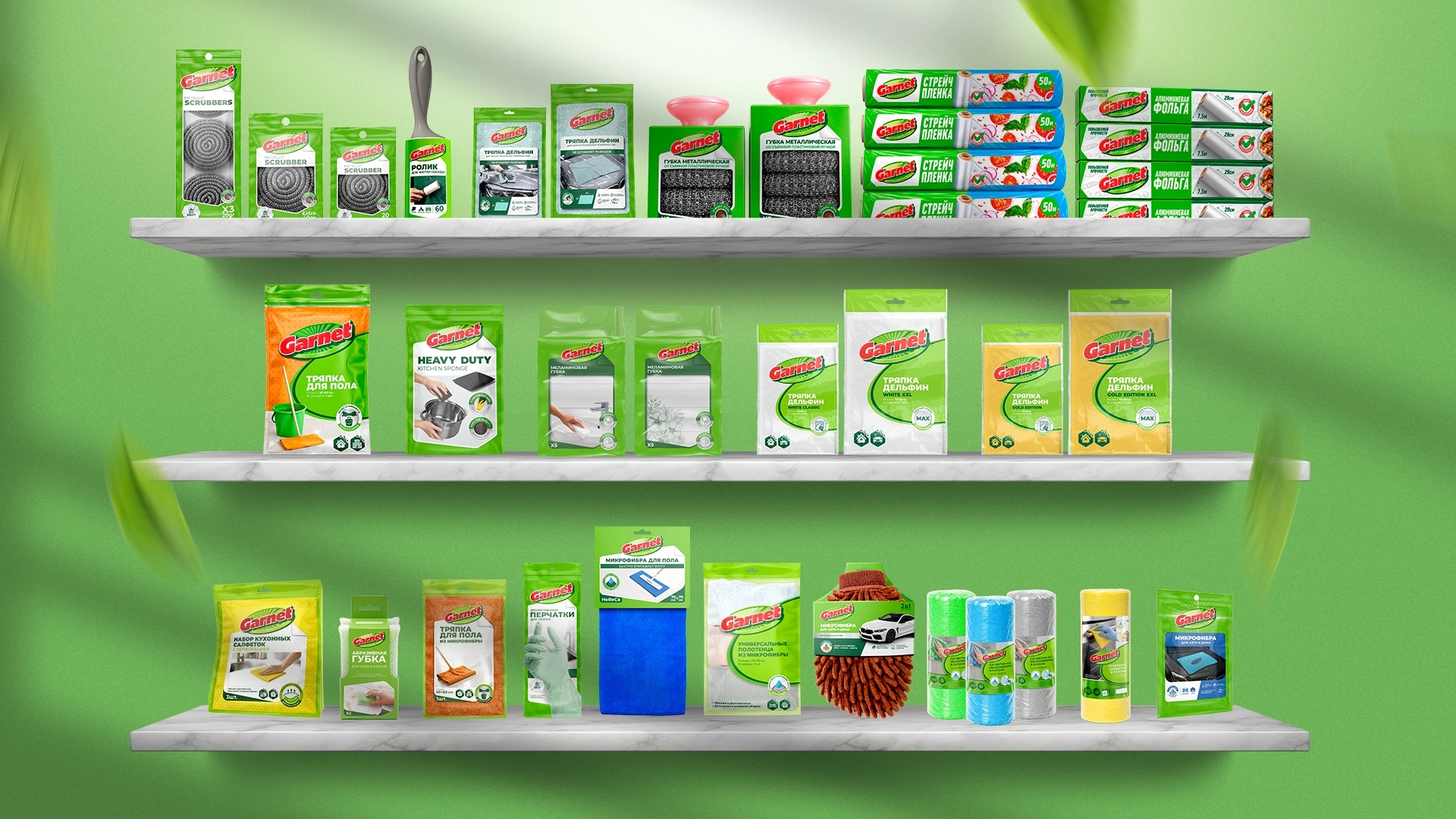
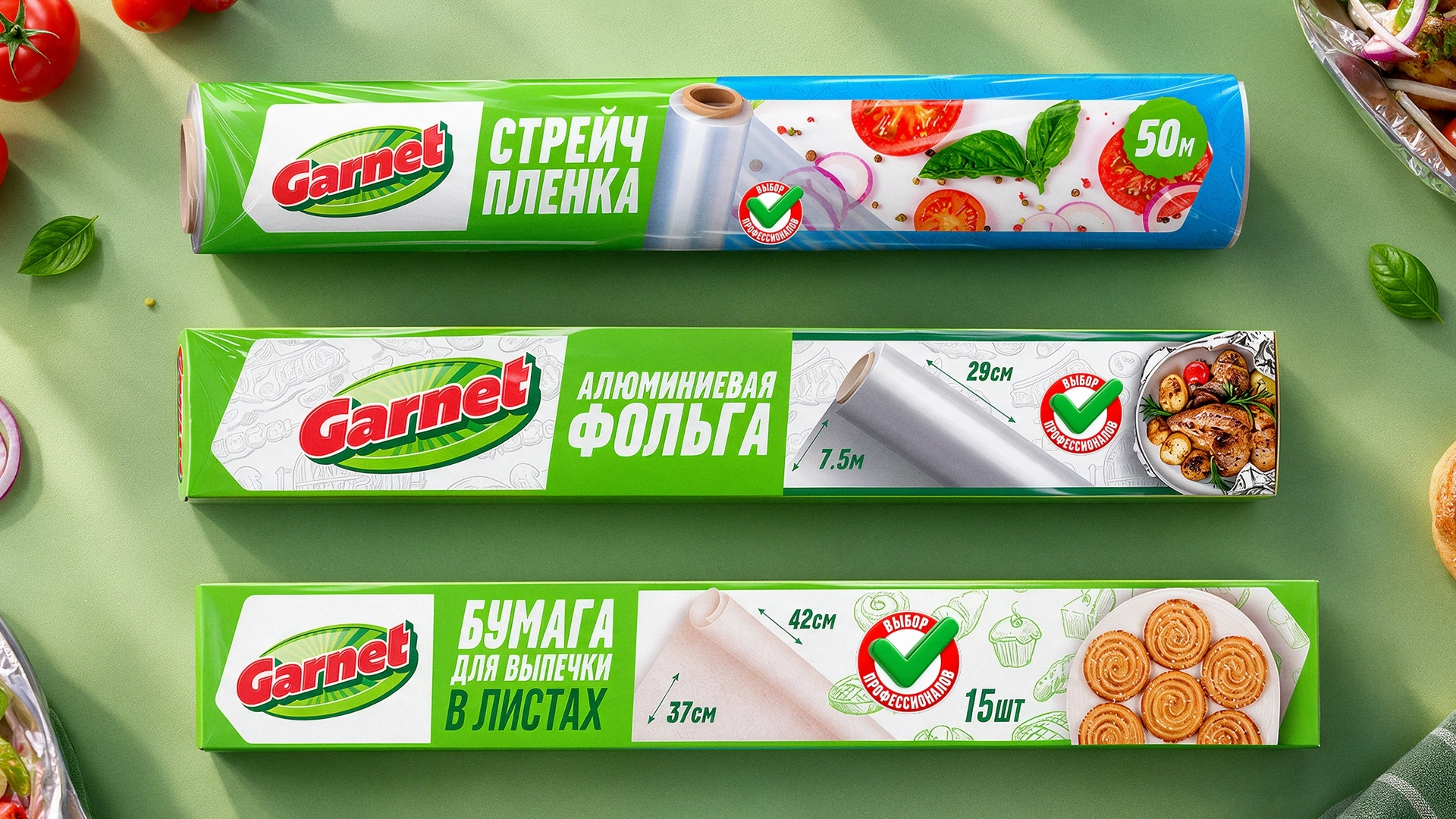
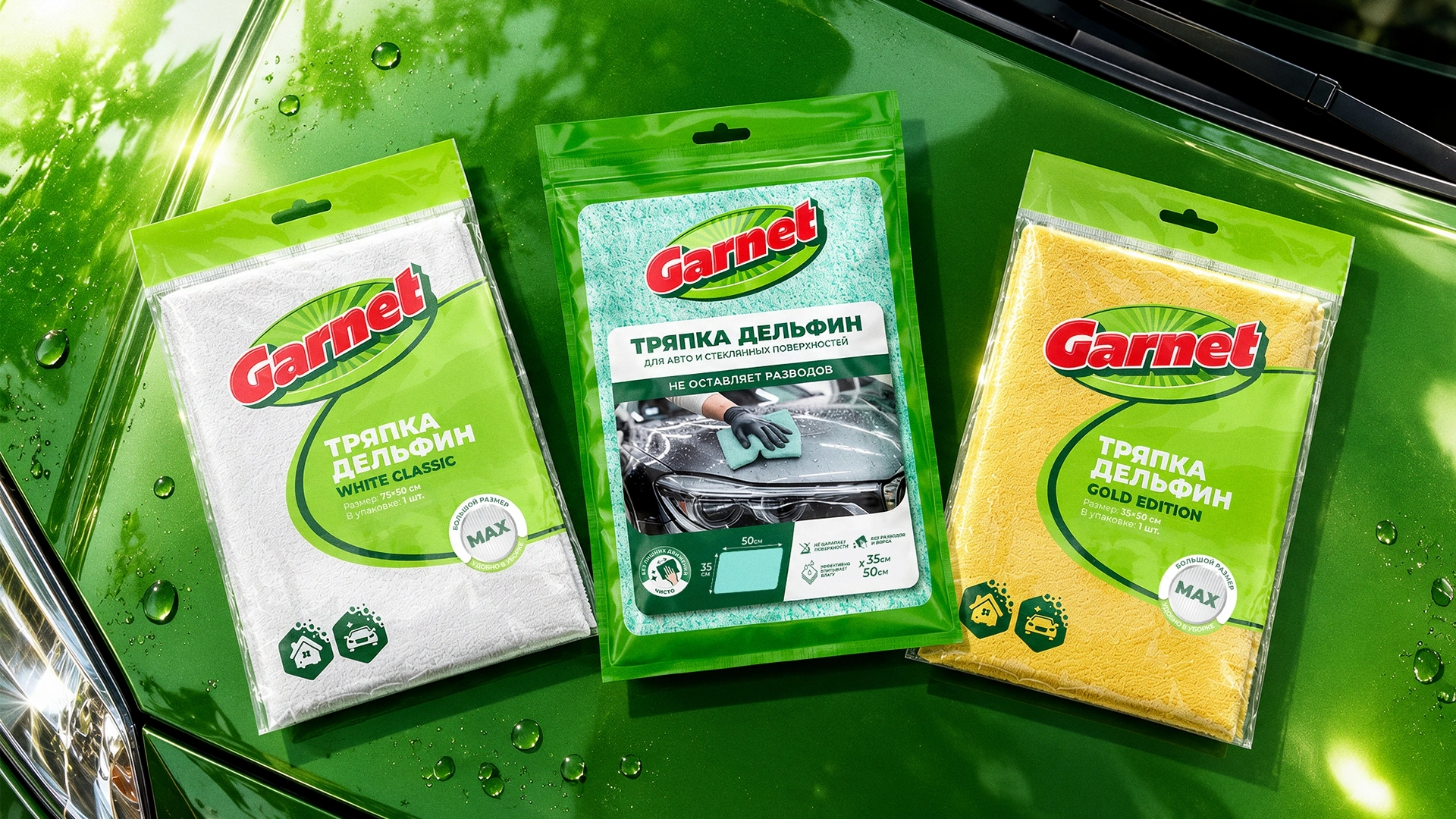
“On a marketplace, packaging is first seen at the size of a stamp, and then opened in the kitchen. So we check the layout at two scales: we shrink the front to a thumbnail in the feed, and separately decide what a person will see when they take off the courier bag.” — Lazizkhuja Sharipov, founder and director of Minim Design
Frequently asked questions
What should the main product photo on Uzum Market look like?
The main photo should show the packaging itself, shot cleanly and without glare, with the brand, product type, variant and size readable at first glance. GS1 names these four attributes as the basis of mobile product images. If they cannot be read in the thumbnail, simplify the packaging rather than loading the photo with extra captions.
Do you need to make separate packaging for the marketplace?
Most often not: it is enough for the front of the pack to be designed for a small scale and readable in the thumbnail. A separate version is justified if the product sells mainly online, if the front is overloaded or if the standard box does not survive delivery. It is better to decide this before the design, not after the first run.
What information must be on the packaging when selling online?
The same as for an ordinary store: selling online does not remove labeling requirements. The exact list for a category is set by the current technical regulations, which should be checked on lex.uz. The Law “On Electronic Commerce” also obliges the seller to give complete information about the product, so the data in the product card must match the packaging.
How can packaging be protected from damage during delivery?
Check the structure before the run: caps and dispensers must lock, and glass and fragile shapes need a protective insert or a corrugated box. The barcode is printed with dark bars on a light background, not on a fold or seam. Check the requirements for supplying the warehouse against Uzum’s current rules in the seller account.
What should you put inside the parcel so the shopper comes back?
Simple things work: an insert with instructions or a recipe in Uzbek and Russian, a card showing the brand’s range and printing on the inside of the box. You can ask for a review, which helps the product card in search. Check the platform rules before printing: links that take the shopper off the marketplace may be restricted.
Key takeaway
A shopper on Uzum first meets packaging at the size of a postage stamp, and only holds it after payment and delivery. That is why packaging for a marketplace is judged not in a presentation on a big screen, but at two points: in the search feed and on the kitchen table after the courier bag. At the first point, what decides is a large product type, a color code for the variant and the size on the front. At the second, a sturdy structure, correct labeling and an insert that leads to a second order. The marketplace does not cancel the shelf; it adds the screen and the road home to it. The winner is packaging designed for all three from the very start.
About the author. Lazizkhuja Sharipov is the founder and director of Minim Design and has led the agency since its founding in 2019.
About Minim Design. Minim Design is a packaging design agency from Tashkent, founded in 2019. The team has more than 20 specialists, and the agency has 1,156 completed projects and exports its services to 12 countries. Minim runs the entire project: naming, logo, packaging design, 3D visualization and print control. The agency’s work has been featured by Packaging of the World, Dieline and the World Brand Design Society.
Sources
- Spot — Uzum Market data on e-commerce, orders, sellers and logistics (23.10.2026, sponsored): spot.uz
- Gazeta.uz — share of small businesses among Uzum Market sellers (09.07.2026, sponsored): gazeta.uz
- National Statistics Committee — retail turnover for January–July 2026 (29.08.2026): stat.uz, PDF
- GS1 Sweden — the four attributes of mobile ready hero images: gs1.se
- University of Cambridge — product image guidelines for mobile shopping and the Unilever test (07.02.2018): cam.ac.uk
- We Project — local brands’ experience on Uzum Market (02.12.2025): weproject.media
- Lex.uz — Law No. ZRU-792 “On Electronic Commerce” of 29.09.2022: lex.uz
- Lex.uz — Cabinet of Ministers Resolution No. 490 of 12.07.2017 on food labeling, lost force on 02.09.2025: lex.uz
Share

Other articles

10.11.2026
Packaging Design Development Stages: How the Minim Agency Works
Before ordering packaging design, a manufacturer wants to know three things: how long it will take, what they will see and at what point they can influence the result. And an explanation of why the result matters to us as much as it does to the client.

10.11.2026
The Food Zone on Packaging: Photo, 3D or Illustration?
The food zone is often chosen by the designer’s taste or by the photo-shoot budget, although the decision should be made by the product, the range and the promise the packaging makes to the shopper. Below is how to match the technique to the task, where each one is weak and how not to promise more with the picture than is in the pack.

10.11.2026
How Much Does Packaging Design Cost in Uzbekistan and How to Choose a Contractor
“How much does packaging design cost?” is a question whose honest answer is “it depends,” which is exactly why it is irritating. Below is what the price is made of, how to compare quotes, what to put in the contract and how to choose a contractor.