


04.11.2026
Agency and Printer in Uzbekistan: How to Hand Over Packaging Artwork Without Paying for a Reprint

A reprint rarely starts on the press floor. It starts earlier, with an email that says “here is the final artwork” and carries no colour specification, no current die line and no signed colour proof. For a foreign brand launching in Uzbekistan, the risk is higher: the artwork is often created at headquarters, adapted by a local agency and printed by a Tashkent printer that none of them has worked with before. Below is what a print handover package should contain, which artwork errors most often lead to a reprint, and how to split responsibility between the agency, the printer and the brand owner.
In short. To avoid paying for a reprint, send the printer a package, not a single file: a print-ready PDF built to the printer’s specification, open source files, the current die line, a colour and finishing specification and a vector barcode. Close every stage — prepress, colour proof, press check — with a written sign-off. Errors then show up before the run, and the contract decides who pays.
Why do reprints start at file handover, not on press?
Because most causes of a bad run are built in before the printer starts the press: in the colour mode of the file, the version of the die line, the fonts and what exactly the client approved. The printer reproduces what it receives. If the file is wrong, the mistake is printed faithfully across the whole run.
The weak point is the hand-off between three parties. The agency assumes the printer’s prepress team will check everything. The printer assumes whoever sent the file is responsible for it. The brand owner saw an image on screen and believes that is what they approved. For an international brand there is often a fourth party — the global design team — and the chain of approvals gets longer.
Local capacity is growing. According to Uzbekistan’s National Statistics Committee, large enterprises produced 10.2 trillion soums’ worth of paper and paper products in 2025, up 10.5% on 2024 (stat.uz, 10 Feb 2026). In January–June 2026 output reached 5.4 trillion soums, up 17.9% year on year (stat.uz, 27 Aug 2026). Judging by these figures, local production is getting busier, so a reprint costs not only money but also a new slot in the printer’s queue.
What should the print handover package include?
It should include everything a print technician needs to print the pack without calling the designer: the print file, source files, die line, specifications and a colour reference.
| What to hand over | Why | Who prepares it |
|---|---|---|
| Print-ready PDF to the printer’s specification | One file with fonts, images and the output profile embedded | Agency |
| Source files with fonts and images | The technician can fix a small issue without rebuilding the artwork | Agency |
| Current die line (cutting template) | Graphics align with cut, fold and glue lines | Printer supplies, agency places |
| Colour specification | Which colours print as CMYK and which as Pantone spot inks | Agency |
| Finishing map | Foil, spot varnish, embossing — each on its own layer | Agency |
| Vector barcode and GTIN | Scans at the till and matches the product listing | Brand owner gives the number, agency places the code |
| Colour reference | Signed colour proof or approved sample to compare the run against | Brand owner signs |
| Cover note | Run length, material, deadlines, contacts | Project manager |
The printer sets the PDF format, so request its specification before design starts. Where there is no specific requirement, printers often ask for PDF/X-4, part of the ISO 15930-7 standard. According to the PDF Association, PDF/X-4 allows live transparency and always requires the output intent ICC profile to be embedded, while the core rule across PDF/X is that fonts are embedded (PDF Association, 1 May 2017).
Local context matters here. Tashkent printers commonly run offset for cartons and flexo for films and labels, while some specialty papers, films and metal tins are usually imported. Minim’s overview of printing technologies in Uzbekistan explains what can be produced locally and where compromises are needed.
Which artwork errors most often cause a reprint?
Most failed runs come not from complex issues but from recurring technical details that slipped through prepress.
- RGB instead of CMYK. A bright screen colour turns dull when converted. If the printer’s software converts it automatically, the client sees a different colour from the one approved.
- No bleed. Background that should run to the edge leaves a white sliver after cutting. The printer sets the bleed size.
- Key elements too close to cut or fold lines. Text, logos and regulatory marks need a safe margin from the die line.
- Outdated die line. The printer changed the construction, but the artwork was built on the old version, and the graphics drift off the panels.
- Fonts not embedded. Uzbek Latin letters such as oʻ and gʻ turn into empty boxes or substituted glyphs. Minim’s article on fonts for Uzbek Latin and Cyrillic covers font choice.
- Hairlines and small reversed-out text. White text on a dark background can fill in with ink, especially on film. Check minimum line weight and type size with the printer.
- Finishes on the same layer as the artwork. Foil, varnish and embossing need their own plates or dies.
- Copy without a final proofread. A mistake in ingredients, shelf life or the manufacturer’s address can only be fixed by reprinting.
How do you check the barcode before the run?
Check it three times: in the artwork for size and colour, on the colour proof with a scanner, and on the first sheets of the run with a scanner again.
- Size. According to GS1 UK, the nominal EAN-13 at 100% measures 37.29 × 22.85 mm including quiet zones, with a module width of 0.330 mm. The smallest option in the GS1 UK table is 80%, or 29.83 × 18.28 mm (GS1 UK). The right size depends on the print process and substrate.
- Height. GS1 UK advises against truncating the barcode height unless absolutely necessary, and resizing must keep proportions.
- Quiet zones. The margins left and right of the code stay clear and match the colour of the spaces between bars.
- Colour and substrate. Scanners read contrast, so use dark bars on a solid light background; black on white is the most reliable. Avoid high-gloss and transparent backgrounds (GS1 Australia).
In Uzbekistan GTINs are issued by GS1 Uzbekistan through its online account at gs1.uz (Buxgalter.uz, 15 Jun 2021). If a product already carries a GTIN from another GS1 country, confirm with your distributor and retail chain whether it can be used as is.
Who checks and signs off what?
Responsibility is split by stage: each stage has an owner, a reviewer and a sign-off that closes it.
- Technical specification before design. The printer states material, print process, number of colours, bleed, minimum line weight and file format. The agency designs to it.
- Agency prepress. The designer assembles the package and checks it against a checklist.
- Printer’s incoming check. The technician reviews the files and sends a written report of what is accepted and what needs fixing.
- Colour proof. The brand owner compares it with expectations and signs it. The signed proof becomes the press reference.
- Press check. First sheets are matched to the reference. On complex jobs it helps if the designer attends.
- First-batch acceptance. Cutting, gluing, finishing and barcode are checked on finished packs.
Who pays for a reprint is set by the contract, so agree on it before work starts. A workable logic: whoever signed off the stage at which the error was visible is responsible. This is a working principle, not legal advice; have a lawyer review the contract wording.
What does this look like in practice at Minim?
At Minim, packaging design includes print supervision: the team prepares the printer’s package, checks colour proofs and, where needed, stays with the project until the product reaches the market.
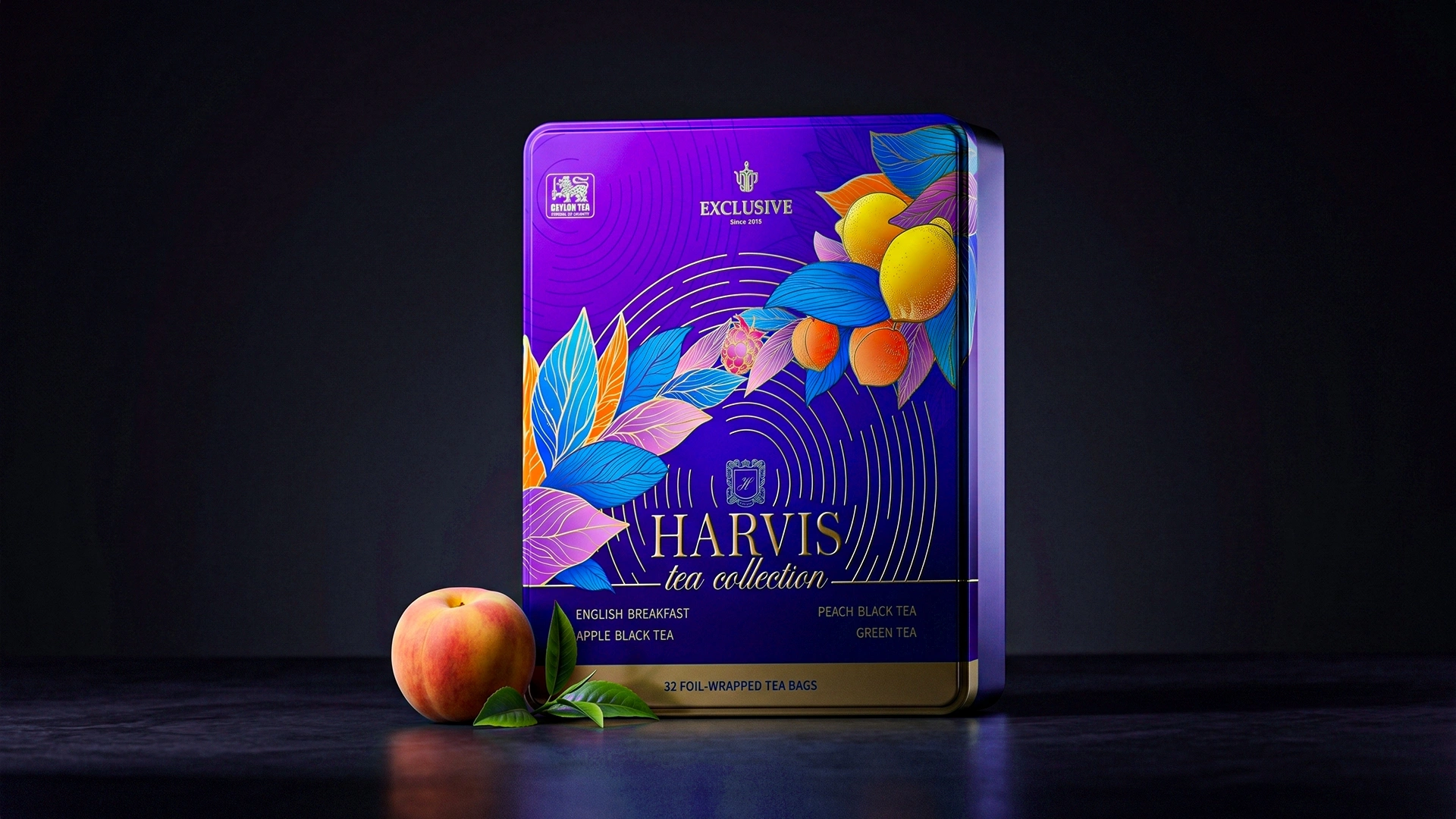
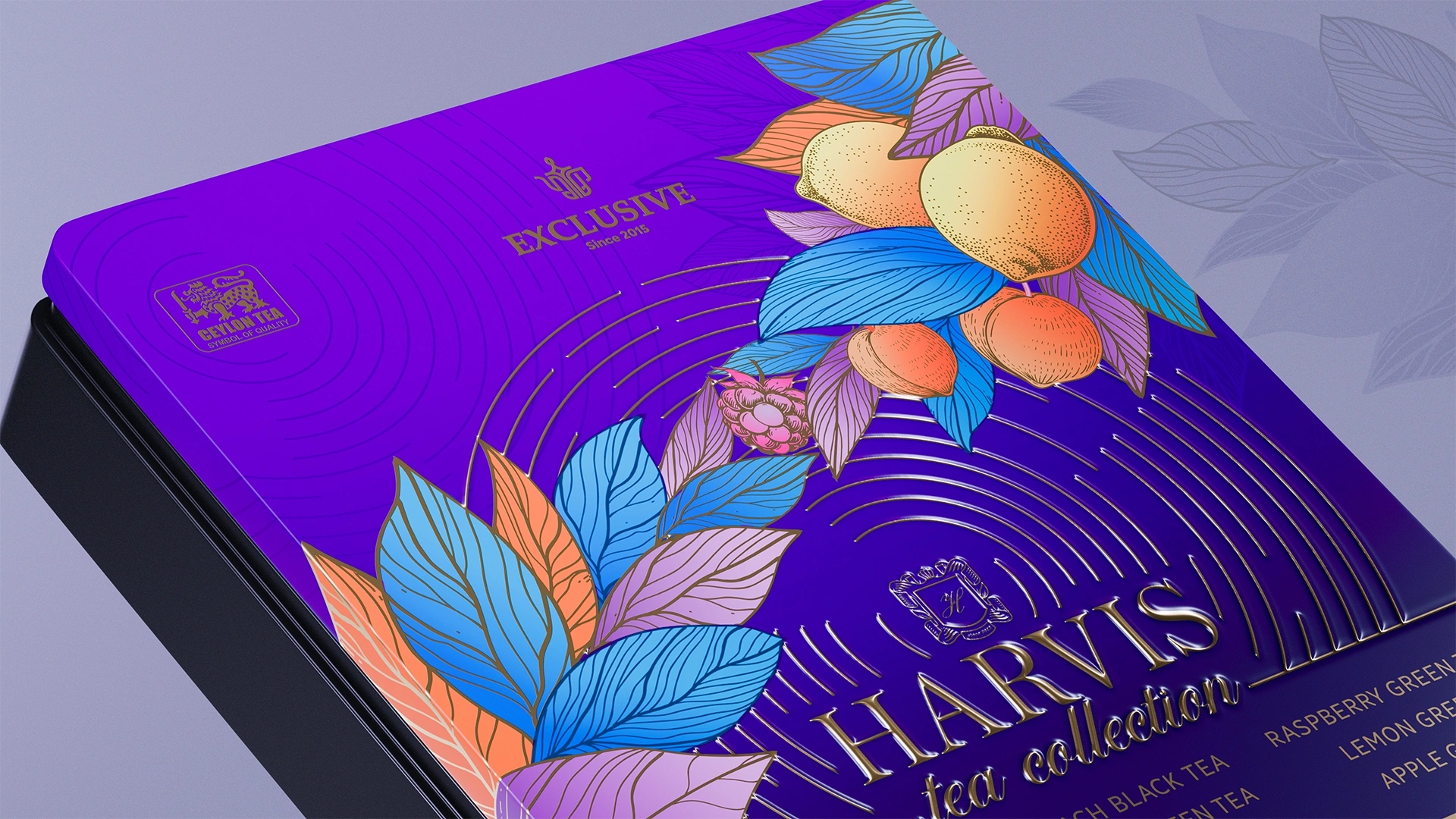
One example is Exclusive Harvis, a premium gift tea range in metal tins with a relief gold pattern, manufactured in China. According to the case page, from the shape of the pack to printing, the agency worked directly with the manufacturers, agreed technical details and supervised the process until the product went to market. After the project, the client entrusted Minim with the design of more than 10 further SKUs.
“A reprint isn’t ordered at the printer. It’s ordered much earlier, when the artwork goes out without a specification and without a signature on the colour proof. That’s why we treat file handover as a separate project stage with its own checklist and its own owner.” — Lazizkhuja Sharipov, founder and director of Minim Design
FAQ
What file format should I send to a packaging printer?
The printer sets the format, so request its specification before design starts. Most often it is a print-ready PDF to a PDF/X standard, such as PDF/X-4, with fonts and the output profile embedded. Send it together with source files, the current die line and a colour specification, so the technician can fix small issues without rebuilding the artwork.
What is bleed and why does it matter?
Bleed is the part of the background or image that extends beyond the cut line. The cutting knife can shift slightly, and without bleed a thin white edge appears on the finished pack. The bleed size depends on the print process and construction, so take it from the specific printer’s technical requirements rather than from habit.
Who pays for a reprint if the artwork has an error?
The contract decides, so agree on the rules in advance. A workable logic is that whoever signed off the stage at which the error was visible is responsible. If the brand owner approved the colour proof, colour is on them. If the printer accepted files without comment and printed off-reference, the responsibility is the printer’s.
Do I need a colour proof for a short run?
Yes, if colour matters for the brand or the artwork uses brand Pantone colours, foil or varnish. A colour proof costs less than reprinting even a short run, and it becomes the reference the press operator matches. For digital printing, a test print on the actual production material is sometimes enough instead of a separate proof.
What size should an EAN-13 barcode be on packaging?
According to GS1 UK, the nominal EAN-13 at 100% is 37.29 × 22.85 mm including quiet zones. The smallest option in the GS1 UK table is 80%, or 29.83 × 18.28 mm. Do not truncate the height unless absolutely necessary, resize only in proportion and print dark bars on a light, solid background.
Key takeaway
A reprint is paid for at the printer but ordered much earlier — when artwork goes out as a single file without a die line, a specification or a signed colour proof. For a brand entering Uzbekistan, protection does not require new software: get the printer’s specification before design, send a package rather than a file, run prepress against a checklist and get written sign-off at every stage. The question of blame then becomes a simple one: who signed off the stage where the error was visible? File handover is not a formality at the end of a project but the last stage of design, the one that decides whether shoppers see the pack the brand actually approved.
About the author. Lazizkhuja Sharipov is the founder and director of Minim Design and has led the agency since it was founded in 2019.
About Minim Design. Minim Design is a packaging design agency based in Tashkent, Uzbekistan, founded in 2019. Its team of more than 20 specialists has completed 1,156 projects and exports its services to 12 countries. Minim covers the full cycle: naming, logo, packaging design, 3D visualization and print supervision. The agency’s work has been featured by Packaging of the World, Dieline and World Brand Design Society.
Sources
- National Statistics Committee of Uzbekistan — paper and paper products output in 2025 (10 Feb 2026): stat.uz
- National Statistics Committee of Uzbekistan — paper products output in January–June 2026 (27 Aug 2026): stat.uz
- PDF Association — requirements of the PDF/X standards, including PDF/X-4 (1 May 2017): pdfa.org
- AFNOR — ISO 15930-7:2010 (PDF/X-4) catalogue entry: boutique.afnor.org
- GS1 UK — EAN-13 sizes and scaling rules: gs1uk.org
- GS1 UK — barcode quiet zones: gs1uk.org
- Buxgalter.uz — how to obtain a barcode through GS1 Uzbekistan (15 Jun 2021): buxgalter.uz
- GS1 Australia — colours and substrates for barcode printing: gs1au.org
Share

Other articles
03.11.2026
Fonts for Uzbek Latin and Cyrillic: How to Typeset Bilingual Packaging for Uzbekistan
A global brand localizes its pack for Uzbekistan, the files are approved, the run is printed — and in the ingredients list the Uzbek letter “oʻ” shows up as “o'” with a straight apostrophe, or as an empty box. It happens when a typeface is chosen because its Latin looks good on screen and the Uzbek characters are only checked on the printing plate. Now there is a second layer: on 21 October 2026 Uzbekistan signed a law that changes four letters of its alphabet. This guide covers which characters your font needs, what the reform changes, how to split two languages between the front and the back, and how to test a typeface before print.

01.11.2026
Gift Sets for New Year, Ramadan and Navruz: When to Start Packaging Design
A gift set that reaches the store after the holiday is not a gift — it is leftover stock. In 2027, Ramadan, March 8, Eid al-Fitr and Navruz will all fall within six weeks. Here is how to calculate the timeline for each holiday, which format to choose, and what to do if you are already late for New Year.

04.10.2026
Brand marketing strategy should be developed before packaging design, not after
If a brief intended for collaboration begins with the words “we just need packaging,” then one very important stage has already been overlooked. The first question from a professional design agency should not be about color or style. The first question should be: what business problem is this packaging supposed to solve? Starting work without answering this question is not merely a theoretical mistake; it is a serious flaw that can lead to major financial losses. One of the most famous failures in global branding practice happened precisely because this question was ignored.