


13.11.2026
From Loose Goods to a Brand: How a Producer Moves from Wholesale to Retail
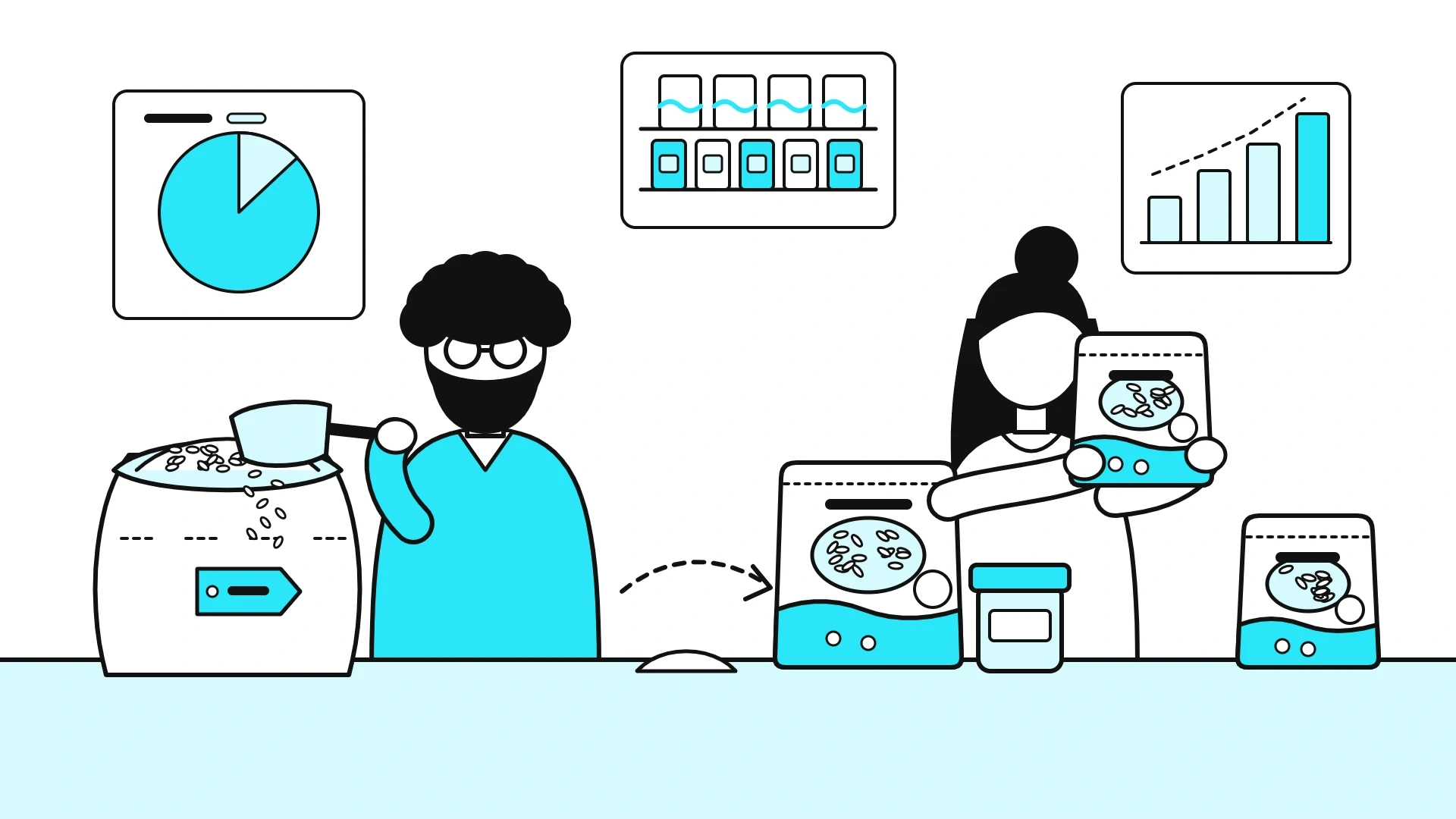
At the bazaar, rice from one sack is no different from rice in the next: shoppers compare the price per kilo and buy from whoever gives a better deal. A producer who sells loose goods by weight is effectively working for the middleman and never meets their own customer. Moving into retail under your own name changes that, but only if decisions are made in the right order. Below: where to start, which channel to choose first, what must be on the pack, and how not to overpay for your first product line.
In short. The move from wholesale to retail starts not with a picture but with four decisions: the shopper, the pack size, the shelf price and the first channel. Then come the name, a pack with the mandatory information, a GS1 barcode and a line of 2–3 SKUs. NielsenIQ estimates that 87% of fast-moving consumer goods (FMCG) sales in Uzbekistan go through traditional trade, so the pack has to sell both at the bazaar and in a supermarket chain.
Why should a producer move from loose goods to their own brand?
A brand gives a producer what wholesale cannot: their own price, a direct connection with the shopper, and repeat purchases that do not depend on a single middleman. Loose goods are compared on price alone, while a packaged product with a name gets bought again because people recognise it.
Shoppers are ready for new names. According to NielsenIQ data presented in October 2025, nine out of ten shoppers in Uzbekistan are open to new brands, 30% actively look for new products, and 54% of shoppers in Tashkent say they are willing to pay more for quality (PR.uz, 03.11.2025).
An important caveat: a brand does not cancel wholesale. Many producers keep selling by weight as their core cash flow and launch packaged goods as a separate line. This lowers the risk and shows exactly where the margin grows. Why the shelf price is set by value to the shopper rather than by production cost is covered in our article on added value.
Where to sell your first packaged product: the bazaar, the corner shop or a chain?
The first channel is chosen where the shopper already is, and for most producers that is traditional trade, not chains. NielsenIQ estimates that in 2025 it accounted for 87% of FMCG sales, while chains such as Korzinka, Havas and Makro took about 13% (PR.uz). Retail remains fragmented: of the 482 trillion soums of retail turnover in 2025, about 83% came from small businesses, according to National Statistics Committee data cited by Halyk Finance (review of 29.07.2026).
At the same time, cities are growing: according to the 2026 census, 54.5% of the population lives in urban areas (stat.uz), and that is where chains and marketplaces are gaining share. The practical takeaway: your first pack must work in several channels at once.
| Channel | What matters for the pack | What to prepare |
|---|---|---|
| Bazaar and corner shop | You can see what is inside right away; the pack survives transport and dust | A window or an honest product photo, sturdy material, net weight in large type on the front |
| Supermarket chain | Recognisable among dozens of neighbours, full information, a barcode | GS1 barcode, a single design system for the line, a document package for the chain |
| Marketplace | The name is legible in a small product card; the pack survives delivery | Pack photos on a white background, a large brand name, protection in transit |
| Wholesale and HoReCa | A convenient large format and clear carton labelling | 5–25 kg packs, transport labelling |
What should be decided before ordering a packaging design?
Before design, six questions need answers: who you are selling to, for what occasion, what goes into the line, in what pack size, at what price, and how the product is different. Without these answers, a designer draws a pack "in general" rather than for a specific shelf. Why marketing decisions come before design is explained in detail in our article on strategy before packaging design.
- Shopper and occasion. A family doing its weekly shop is looking for one thing; someone grabbing a snack at the checkout wants another.
- Starter line. Two or three SKUs (stock-keeping units) that are sure to sell are better than ten at once: each item means its own artwork, barcode and print run.
- Pack size. Weight and format to suit the channel: 1 kg for the corner shop, 5 kg for a family purchase, small packs for impulse buys.
- Shelf price. Calculate the retail price including the shop's markup and compare it with your shelf neighbours, not with your own wholesale price.
- Name. One that is easy to say in Uzbek and Russian and can be registered as a trademark. How names are searched and checked can be seen in our naming service.
- Difference. One idea that makes people pick the product off the shelf: origin, taste, naturalness or convenience.
What labelling and documents does a packaged product need?
A packaged product needs full information for the shopper, a barcode for retailers and, in some categories, digital marking. Loose goods are often sold with no label at all, so for a former wholesaler this is the newest and riskiest part.
- Mandatory information. Product name, ingredients, net weight, production and expiry dates, storage conditions, the manufacturer and its address. This set was fixed by the General Technical Regulation on Food Labelling (Cabinet of Ministers Resolution No. 490 of 12.07.2017), but it lost force on 2 September 2025 (lex.uz). According to the beverage producers' association UzBev, the new technical regulation on labelling has not yet been finally approved (Gazeta.uz, 13.10.2026). Until it is adopted, it is sensible to keep the full set of information and check requirements with a certification body.
- Language. Shopper-facing text is written in Uzbek, with Russian added as a second language. According to the 2026 census, Uzbek is the main language of communication for 91.3% of residents (stat.uz).
- Barcode. Chains will not accept goods without one. In Uzbekistan, GTIN numbers are issued by the GS1 Uzbekistan association through a personal account on gs1.uz (Buxgalter.uz). Each pack size and each flavour needs its own code.
- Digital marking. Some categories require an Asl belgisi DataMatrix code: for example, water and soft drinks are marked under Cabinet of Ministers Resolution No. 631 of 01.11.2022 (lex.uz). The list keeps growing, so check your category before printing and leave space for the code.
- Marks and claims. "Halal", "eco" and conformity marks go on the pack only when backed by a document. How halal certification works is explained in our article on halal certification in Uzbekistan.
How to make your first pack without overpaying?
Savings come not from cheap artwork but from a system: one visual base for the whole line, where as few elements as possible change from product to product. Then a new SKU means a new photo and a new caption, not a new project.
- One system instead of separate layouts. A shared grid, typeface and colour coding for flavours or varieties let you add items without a new design.
- Fewer inks. Put the limit on print colours into the brief from the start: every extra ink adds cost to every print run.
- A shared pack with a changeable sticker. For small batches, one print run of packaging for several products plus a sticker with the ingredients on the back costs less than separate printing for each SKU.
- A trial batch. A short digital print run helps test demand before a large order.
- Material to suit the channel. The bazaar and delivery need sturdy packaging that does not tear or crumple; chains need packaging that holds its shape on the shelf.
What this looks like in practice: Minim case studies
Two of the agency's projects show the move from a "faceless" product to a brand in categories where shoppers are used to buying by weight.
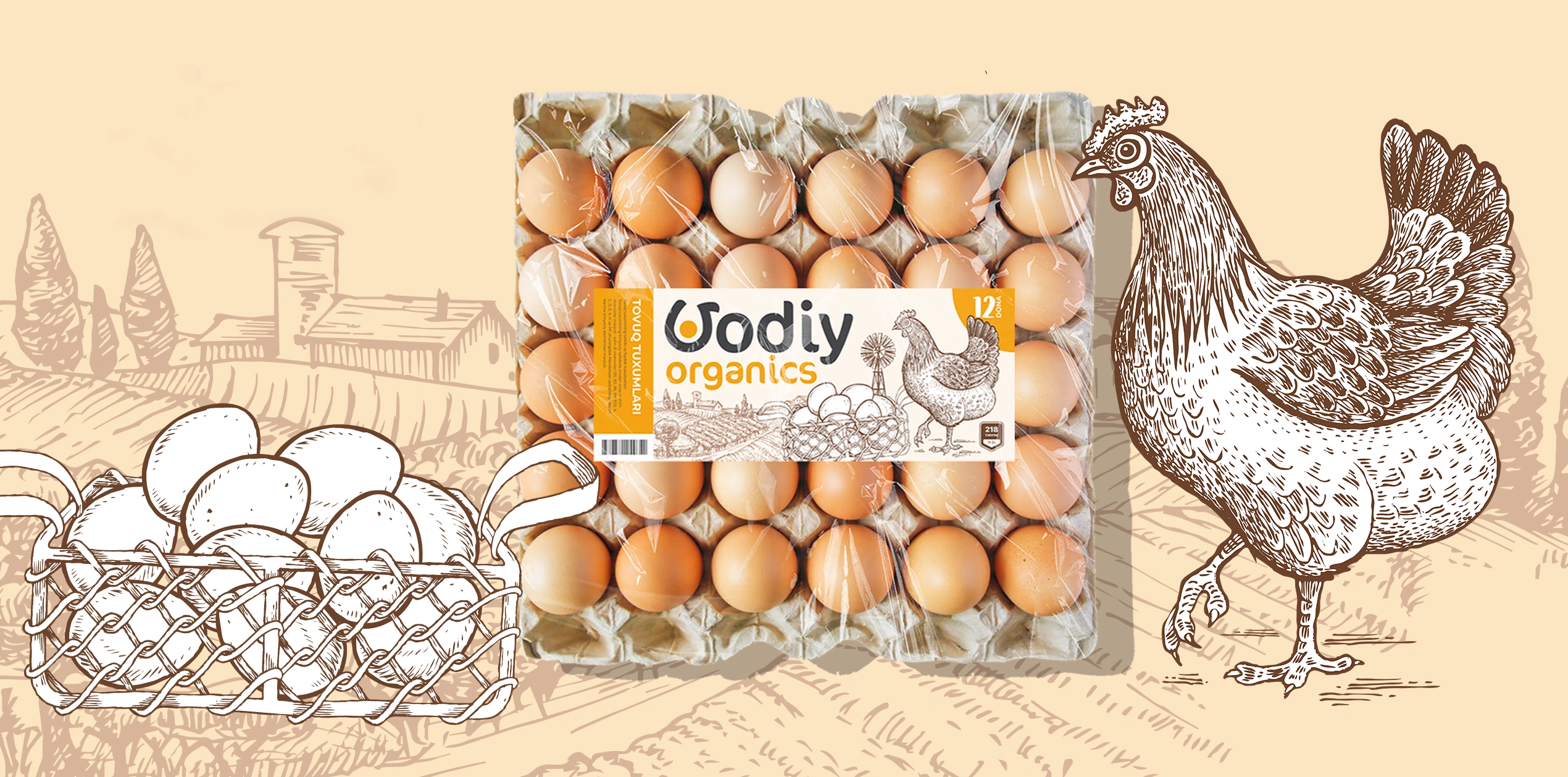
Vodiy Organics: eggs that stopped looking like "bazaar eggs". The entrepreneur wanted to enter the organic egg market as a serious brand and stand apart from the bazaar style, where there is often no label at all, and from competitors with look-alike designs. Minim created the name, logo and packaging. Research showed that for shoppers in Uzbekistan eggs are linked with prosperity, a full table and family breakfast, and people prefer "homemade" and "village" products. So the pack sells the cosiness of village life rather than the feel of a factory: the letter "V" hints at a hen's silhouette and a fried egg, the illustration is drawn in thin lines, and the warm yellow recalls the sun and the yolk.
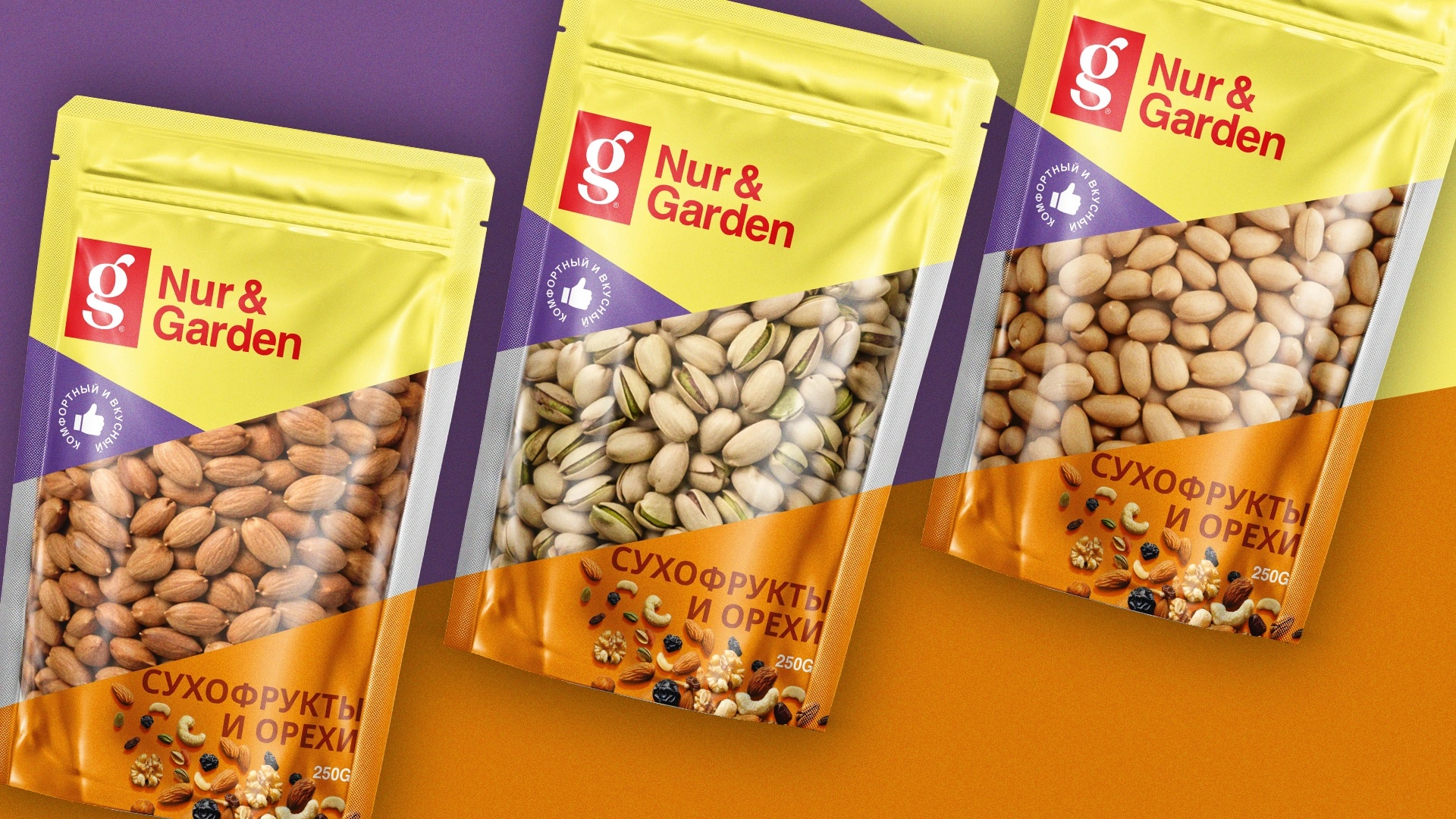
Nur&Garden: rice that grew into a product line. A young entrepreneur was launching a rice brand in 1 kg and 5 kg packs. The design was limited to six print inks, and the system was built from the start with future products in mind: geometric lines and a clear window in the centre, where only the image of the dish changes. The client came back with lines of green tea and dried fruit. Pistachios, almonds, peanuts, raisins and dried apricots got one shared design, and only the information sticker on the back changes from product to product, which cuts the producer's costs.

"As long as a product is sold by weight, it is the middleman who talks to the shopper. Once a product has a name and a pack, the producer talks to the shopper directly for the first time, and the pack has to say the most important thing before anyone even picks it up." — Lazizkhuja Sharipov, founder and director of Minim Design
Frequently asked questions
Where should the move from wholesale to retail start?
Start with decisions, not with design: define the shopper, a starter line of 2–3 items, the pack size and the shelf price including the shop's markup. Then choose your first sales channel, come up with a name and check it as a trademark. Only after that should you order the packaging, barcodes and a trial batch.
How many SKUs should you launch with?
It usually makes sense to start with two or three items that already sell well by weight. Each new item needs its own artwork, barcode and print run, which means money and warehouse space. Once the first SKUs are established on the shelf, the line is expanded within the same visual system, without a new design.
Do I need a barcode if I only sell at the bazaar and in corner shops?
Formally, a small outlet may accept goods without one, but the very first chain or marketplace will ask for a GS1 barcode. Reprinting packaging to add a code costs more than including it from the start. In Uzbekistan, GTIN numbers are issued by GS1 Uzbekistan, and every pack size and flavour needs its own code.
Can you sell both by weight and under a brand at the same time?
Yes, many producers do exactly that: selling by weight remains the core cash flow, while the branded packaged goods run as a separate line. The key is not to sell the same product side by side at very different prices. Shoppers should understand what they are paying more for: selected raw materials, packaging, convenience or a quality guarantee.
Which labelling requirements apply after Resolution No. 490 was cancelled?
Regulation No. 490 lost force on 2 September 2025, and as of October 2026 the new technical regulation on labelling has not been finally approved. Until it is adopted, it is safer to state the full set of information: name, ingredients, net weight, dates, storage conditions and manufacturer. Check the requirements for your category with a certification body.
Should you register a trademark before launch?
It is best to file the application before the first print run. If the name turns out to be taken, the packaging will have to change after launch and the investment in recognition will be lost. Names are checked against trademark databases at the naming stage, so you can pick an option that can be protected in Uzbekistan and in future export markets.
Key takeaway
A sack of loose goods is sold by its price; a packaged product is sold by its name. Moving from wholesale to retail is not new packaging for an old product but a new sales model, in which the producer is responsible for how the product looks, what it says and where it stands. Start with decisions about the shopper, pack size, price and channel, then add the name, labelling and barcode. The market is ready: traditional trade still accounts for most sales, and shoppers are open to new brands. One packaging system for the whole line and a starter set of 2–3 SKUs let you make this journey without unnecessary costs and test demand before large print runs.
About the author. Lazizkhuja Sharipov is the founder and director of Minim Design and has led the agency since it was founded in 2019.
About Minim Design. Minim Design is a packaging design agency based in Tashkent, founded in 2019. The team has more than 20 specialists, and the agency has completed 1,156 projects and exported its services to 12 countries. Minim handles projects end to end: naming, logo, packaging design, 3D visualisation and print supervision. The agency's work has been featured by Packaging of the World, Dieline and the World Brand Design Society.
Sources
- PR.uz — NielsenIQ data on Uzbekistan's FMCG market, the share of traditional trade and attitudes to new brands (03.11.2025): pr.uz
- Halyk Finance — review of retail trade in Uzbekistan based on National Statistics Committee data (29.07.2026): halykfinance.kz, PDF
- 2026 population census results — urban population and languages of communication: stat.uz, PDF
- Lex.uz — Cabinet of Ministers Resolution No. 490 of 12.07.2017, marked as no longer in force from 02.09.2025: lex.uz
- Gazeta.uz — draft labelling of sugary drinks and the status of the new technical regulation on labelling (13.10.2026): gazeta.uz
- Lex.uz — Cabinet of Ministers Resolution No. 631 of 01.11.2022 on digital marking of water and soft drinks: lex.uz
- Buxgalter.uz — how to get a barcode through GS1 Uzbekistan (15.06.2021): buxgalter.uz
Share

Other articles
13.11.2026
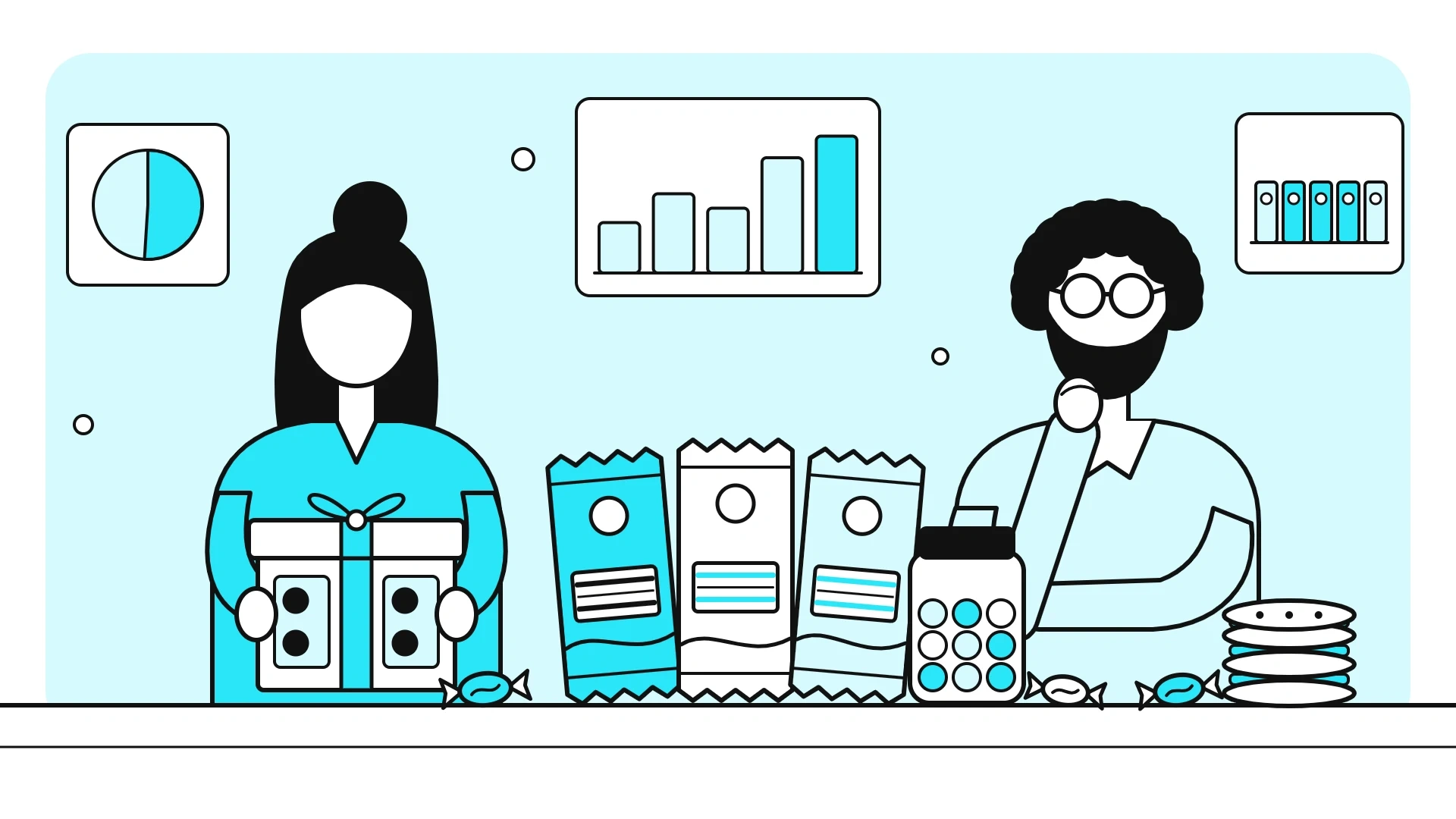
Confectionery Packaging Design: Wafers, Sweets and Biscuits
A pack of wafers is taken off the shelf in a couple of seconds, and shoppers rarely compare ingredients. Below we look at how confectionery packaging design differs for wafers, sweets and biscuits, how to show flavour through film, when a window is needed, and how to keep a range of a dozen flavours in order.

11.11.2026
Short runs and digital packaging printing: when they pay off
The most expensive packaging is the packaging sitting in a warehouse. Below: how digital differs from offset and flexo, how to calculate the break-even point between them, when a short run pays off and how to prepare the design for it.

10.11.2026
Packaging Design Development Stages: How the Minim Agency Works
Before ordering packaging design, a manufacturer wants to know three things: how long it will take, what they will see and at what point they can influence the result. And an explanation of why the result matters to us as much as it does to the client.