


01.11.2026
Gift Sets for New Year, Ramadan and Navruz: When to Start Packaging Design

A gift set that reaches the store after the holiday is not a gift — it is leftover stock. The mistake is almost always the same: the timeline is counted from the holiday date, when it should be counted from the day the set has to be on the shelf. In 2027 this mistake will cost more than usual: Ramadan, March 8, Eid al-Fitr (Ramazon Hayiti) and Navruz will all fit into six weeks, from 8 February to 21 March. Below is how to calculate the timeline for each holiday, which format to choose, and what to do if you are already late for New Year.
In short. Count the timeline backwards from the day the set must be on the shelf. If the whole chain — design, sample, production and assembly — takes about 12 weeks, packaging for Ramadan 2027 (expected from 8 February) needs to start in the first half of November, and for Navruz in early December. A full cycle will no longer fit before New Year: a sleeve, a sticker or a stock box with a new label will save the day.
When should gift packaging design start for each holiday?
Start from the end: set the day the gift set has to appear on the shelf and subtract the length of the whole chain. As an example, take a chain of four segments: 5 weeks for design and approval, one week for prepress and a sample, 4 weeks for box production and 2 weeks to assemble the sets and deliver them to retail chains. That is 12 weeks in total. These are indicative figures: plug in the lead times of your own printer and distributor.
| Holiday | Date | Set on the shelf | Artwork to print | Design starts |
|---|---|---|---|---|
| New Year | 1 January 2027 | by 10 December | 29 October | 17 September — deadline passed |
| Ramadan | around 8 February 2027 | by 1 February | 21 December | 9 November |
| March 8 | 8 March 2027 | by 22 February | 11 January | 30 November |
| Navruz | 21 March 2027 | by 1 March | 18 January | 7 December |
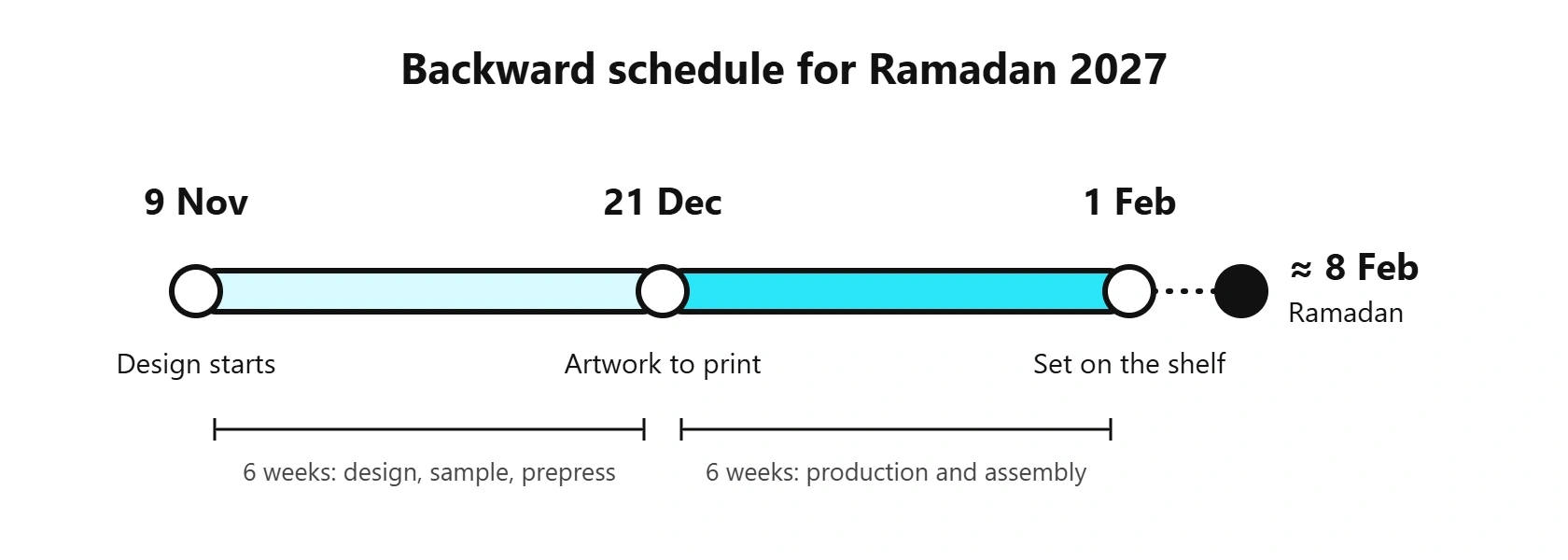
Eid al-Fitr is expected around 9 March. It does not need a separate production wave: Eid gift sets should be on the shelf throughout Ramadan.
Three factors shift these dates:
- Ramadan starts earlier every year. It follows the lunar calendar and begins about 11 days earlier than the year before. In Uzbekistan, Ramadan 2026 began on 19 February (Zamin.uz), and in 2027 it is calculated to begin around 8 February (Wego). The exact date is announced by the Muslim Board of Uzbekistan.
- Production for Ramadan falls over the New Year holidays. Build some buffer into the period from 21 December to 18 January.
- Spring Festival in China. If your boxes are made in China, note that Chinese New Year falls on 6 February in 2027. Logistics company SEKO warns that factories start to reduce capacity several weeks before the holiday and take weeks to get back to normal pace afterwards. SEKO advises completing production for this season by late November — early December 2026 (SEKO, 28.10.2026).
What makes up the timeline, and where is time lost?
The timeline consists of six stages, and approvals and complex box construction usually eat up the most time.
- Brief and set contents. Until it is decided what goes into the set, who it is for and what it costs, the structural designer cannot calculate the insert — the tray that holds the products in place. Why marketing decisions are made before design is covered in our article on strategy before packaging design.
- Design and approval. Rounds of revisions and the number of people signing off on the artwork stretch the timeline. Agree in advance who makes the final decision.
- Structure and white sample. For a box with a magnet, a window or an insert, a “white” unprinted sample is made first: it shows how the products sit and how the lid closes.
- Prepress and colour proof. Files are prepared for print and the colour is checked. Gold, foil and embossing need a separate check; what can realistically be printed in Uzbekistan is explained in our article on printing technologies.
- Production. Printing, lamination, embossing, die-cutting, assembly. Rigid (wrapped) boxes are often assembled by hand, so they take longer than folding cartons. If the packaging is made abroad, shipping and customs are added to the timeline.
- Set assembly and logistics. Decide in advance who assembles the sets — the manufacturer, the distributor or a co-packer — whether a shipping carton is needed, and when the retail chain accepts the goods.
Which gift packaging format should you choose?
The format comes down to three questions: how much time is left, how much the set costs and who it is for. The less time you have, the higher up the table you will need to choose.
| Format | When it fits | Preparation time |
|---|---|---|
| Sticker on the existing pack | A festive accent on a small budget | Minimal |
| Sleeve (band) on the existing pack | A seasonal version of a regular product | Minimal |
| Stock box with your own label | The set is needed urgently and there is no custom structure | Short |
| Folding carton with an insert | A mass-market set for retail chains | Medium |
| Box with a window | The product sells itself: colour, shape, texture | Medium |
| Cardboard or metal tube | Tea, sweets, cosmetics; the pack stays in the home | Medium or long |
| Rigid magnetic box | Premium and corporate gifts | Long |
For New Year 2027, the first three rows and a short digital print run are realistic. If you start on the dates in the first table, any format is available for Ramadan and Navruz.
How do you make a set feel like a gift, not just expensive?
What makes a set a gift is not the price but an occasion that reads at first glance and the care a person feels when opening it. And the fight for the holiday shelf is getting tougher: retail turnover in Uzbekistan in January–September 2026 was 119.7% of the same period in 2025 (National Statistics Committee).
- Occasion without the souvenir clichés. It is better to convey the holiday through one strong idea than to cram every symbol onto the box: spring greenery for Navruz, evening light and a crescent for Ramadan.
- The gifting scenario. During Ramadan people invite each other to iftar, at Eid they visit relatives and neighbours, and nobody goes visiting empty-handed. The set should be easy to carry and look worthy on the dastarkhan, the festive table.
- Opening as part of the gift. The insert, the order in which the products are revealed, a place for a card — all of this turns a box into a gesture of attention.
- A second life for the pack. A tube, a keepsake box or a tin that stays in the home keeps showing the brand after the holiday.
- Greetings in the buyer’s language. According to the 2026 census, Uzbek is the main language of communication for 91.3% of the country’s residents (stat.uz). Uzbek greeting text is best written in Uzbek from the start: a literal translation from Russian sounds stiff.
One design for all holidays or a separate one for each?
More often it makes sense to have one base structure plus a seasonal layer: a sleeve, a sticker or an interchangeable print on the lid. One die, one insert and one supplier reduce one-off costs, while seasonal elements can be printed in small runs closer to the holiday. In 2027 this approach is especially convenient: the base box is produced in one wave by 1 February, and the layers for March 8 and Navruz are added later.
A separate design is justified when the holidays have different buyers. A March 8 set is chosen as a gift for women, a Ramadan set for the family table, and one box may not suit both scenarios.
What should you consider when labelling a gift set?
For a store, a set is a separate product, so it needs its own barcode and clear information on the outer pack.
- Its own GTIN. Under GS1 rules, a predefined assortment is a separate trade item with its own GTIN, and any change of product inside requires a new code (GS1). If your Ramadan and Navruz sets differ in contents, they are two different products. In Uzbekistan, numbers are issued by the GS1 Uzbekistan association through a personal account on gs1.uz (Buxgalter.uz).
- Shelf life. Go by the product with the shortest shelf life: the set cannot be kept longer than that.
- Contents on the box. If the products inside are not visible, list them on the outer pack so that both the buyer and the retailer know what they are buying.
- Category requirements. Check the mandatory labelling of every product in the set: food, cosmetics and drinks have different requirements. If the box will carry a Halal mark, the certificate must cover the products inside; how certification works is explained in our article on Halal certification in Uzbekistan.
What it looks like in practice: Minim gift projects
All of the agency’s gift projects are collected in the Gift Packaging section. Three of them show different tasks.
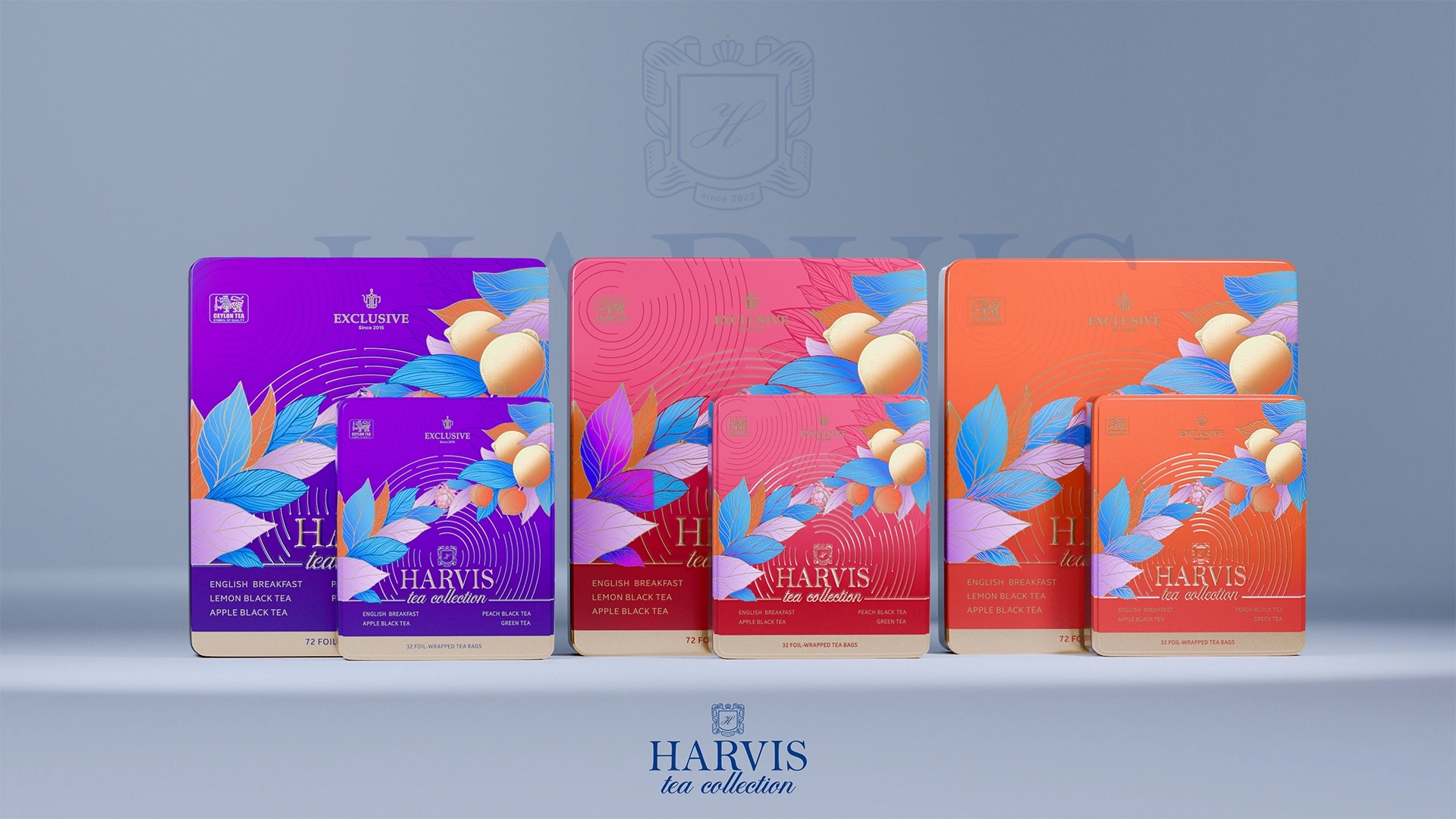
Exclusive Harvis: a gift without wrapping paper. The client needed tea packaging that does not have to be wrapped and says at first glance that this is an expensive gift — for men and women alike. Minim designed the premium range in metal tubes in three colours — royal blue, dark red and emerald — with an embossed gold pattern. The tube stays in the home after the tea is gone. The agency took the project through to print and worked directly with manufacturers in China, and the client came back with an order for another 10+ SKUs.
ON: a corporate gift. ON men’s cosmetics are often bought as gifts for business people, so the packaging has to look substantial. Minim created a gift box with magnetic and leather elements in dark brown and black tones.

Doctor Ali: a gift that is easy to carry. The Alibobo X.O elixir needed a “2 in 1” format — two bottles in one box. Windows show the colour of the drink and the shape of the bottle, deep green with gold embossing signals premium quality, corrugated board provides strength, and an ergonomic handle lets you carry the box in plain sight.

“A gift set is chosen with the eyes and given with the hands. That is why we start a project not with a picture but with the date the set has to be on the shelf, and count the timeline backwards.” — Lazizkhuja Sharipov, founder and director of Minim Design
Frequently asked questions
When does Ramadan start in 2027?
According to astronomical calculations, around 8 February 2027, with Eid al-Fitr expected around 9 March. In Uzbekistan the exact dates are announced by the Muslim Board after the new moon is sighted. For packaging planning, take the calculated date and allow a buffer of a few days either way.
When should you order gift packaging design for Navruz 2027?
Navruz is on 21 March. For the set to be on the shelf by 1 March with a 12-week chain, design needs to start in early December 2026 and artwork needs to go to print in mid-January. If you already have a box and only the seasonal layer changes, the timeline is shorter.
Can you still make gift packaging for New Year if you start in November?
With a new box structure it is risky: design, sampling and production need more time than is left before mid-December. Realistic options are a sleeve or sticker on the existing pack, a stock box with your own label, or a short digital print run. It makes more sense to prepare a new box for Ramadan.
Does a gift set need its own barcode?
Yes. Under GS1 rules, a predefined assortment is a separate trade item with its own GTIN, and any change of product inside requires a new code. The barcodes of the products inside the set stay the same. In Uzbekistan, numbers are issued by the GS1 Uzbekistan association through a personal account on gs1.uz.
Which is more cost-effective: one design for all holidays or a separate one for each?
More often, one base structure plus a seasonal layer: a sleeve, a sticker or an interchangeable print. One die and one insert reduce one-off costs, and seasonal elements can be printed in small runs closer to the holiday. A separate design is justified when the holidays have different buyers and different gifting scenarios.
How does Chinese New Year affect gift packaging timelines?
If your boxes are made in China, factor in the Spring Festival: in 2027 it falls on 6 February. Factories reduce capacity several weeks before the holiday and take weeks to recover afterwards, so production for Ramadan and Navruz is best completed by late November — early December 2026.
Key takeaway
A set that is late for the shelf loses before it ever meets the buyer. Gift packaging is won not on the shelf but in the calendar: count the timeline backwards from the shelf date, and it becomes clear that work for Ramadan 2027 starts as early as November, while Navruz needs decisions before New Year. If your boxes are made abroad, add shipping and the holidays in the supplier’s country to the calculation. A gift box, like a present, is only worth something on time. One base structure, a seasonal layer and an honest timeline let you get through the whole season — from New Year to Navruz — without last-minute rushes.
About the author. Lazizkhuja Sharipov is the founder and director of Minim Design and has led the agency since it was founded in 2019.
About Minim Design. Minim Design is a packaging design agency from Tashkent, founded in 2019. The team has more than 20 specialists, and the agency has completed 1156 projects and exports its services to 12 countries. Minim runs projects end to end: naming, logo, packaging design, 3D visualisation and print supervision. The agency’s work has been featured by Packaging of the World, Dieline and the World Brand Design Society.
Sources
- Wego — expected dates of Ramadan and Eid al-Fitr in 2027: blog.wego.com
- Zamin.uz — start of Ramadan 2026 in Uzbekistan: zamin.uz
- SEKO Logistics — Chinese New Year 2027 and factory shutdowns (28.10.2026): sekologistics.com
- National Statistics Committee — retail turnover for January–September 2026: stat.uz
- 2026 population census results — languages of communication: stat.uz, PDF
- GS1 — GTIN for predefined assortments: gs1.org
- Buxgalter.uz — how to get a barcode through GS1 Uzbekistan (15.06.2021): buxgalter.uz
Share

Other articles

04.11.2026
Agency and Printer in Uzbekistan: How to Hand Over Packaging Artwork Without Paying for a Reprint
A reprint rarely starts on the press floor. Below is what a print handover package should contain, which artwork errors most often lead to a reprint, and how to split responsibility between the agency, the printer and the brand owner.
03.11.2026
Fonts for Uzbek Latin and Cyrillic: How to Typeset Bilingual Packaging for Uzbekistan
A global brand localizes its pack for Uzbekistan, the files are approved, the run is printed — and in the ingredients list the Uzbek letter “oʻ” shows up as “o'” with a straight apostrophe, or as an empty box. It happens when a typeface is chosen because its Latin looks good on screen and the Uzbek characters are only checked on the printing plate. Now there is a second layer: on 21 October 2026 Uzbekistan signed a law that changes four letters of its alphabet. This guide covers which characters your font needs, what the reform changes, how to split two languages between the front and the back, and how to test a typeface before print.

04.10.2026
Brand marketing strategy should be developed before packaging design, not after
If a brief intended for collaboration begins with the words “we just need packaging,” then one very important stage has already been overlooked. The first question from a professional design agency should not be about color or style. The first question should be: what business problem is this packaging supposed to solve? Starting work without answering this question is not merely a theoretical mistake; it is a serious flaw that can lead to major financial losses. One of the most famous failures in global branding practice happened precisely because this question was ignored.