


25.11.2026
AI in packaging design: what it speeds up and where you still need a designer
"AI can draw a package in a minute" — that is true, and it is exactly why such packaging rarely makes it to the shelf. A generated image answers the question of what a pack could look like. Sales, however, depend on other questions: how the brand differs from its neighbours, how a range of fifteen flavours stays one family, what must be on the label and how the file will behave at the print shop. Below is where AI genuinely saves time, where it gets things wrong, and how to split the work between the generator and the designer.
In short. AI speeds up idea search, moodboards, rough visuals, mockups and marketplace images. Brand strategy, the range system, copy and labeling, prepress and rights clearance are still done by people. According to a 2026 study by T&T Design Group, shoppers trust packaging that a designer created together with AI more than fully generated packaging.
What can AI already do in packaging design?
AI performs well where many options are needed fast and the cost of a mistake is low: in the early stages of a project and in supporting graphics. A survey by Adobe and research firm Advanis, published on 17 April 2026, found that 94% of more than 400 creative professionals surveyed produce content faster with AI, and they put the time saved at 17 hours a week on average (Adobe).
| Stage | What AI speeds up | What stays with the designer |
|---|---|---|
| Research | Moodboards, style and colour palette collections | Choosing the direction that serves the brand's goal |
| Ideation | Dozens of quick sketches | An idea derived from an insight, and filtering out the derivative |
| Food zone and illustrations | Rough product images, backgrounds, textures | A credible product and one consistent style across all SKUs |
| Mockups | The pack on a shelf, in a hand, in an interior | Checking on the real dieline and material |
| Copy | Draft descriptions and lists of name options | Meaning, labeling rules, trademark checks |
| Marketplaces | Backgrounds and infographics for product cards | Making sure the image matches the real package |
The practical consequence: the time gain falls at the start and the end of a project, while the middle — strategy, system and production — shrinks very little. The state is betting on AI too: Uzbekistan's Strategy for the Development of Artificial Intelligence Technologies until 2030, approved by Presidential Decree PP-358 of 14 October 2024, aims to grow the market for AI-based software and services to 1.5 billion dollars (Ministry of Digital Technologies). The tools will keep getting more accessible, so the question is not whether to use them but what to hand over to them.
Why does packaging made only by AI lose?
It gets noticed, but it is trusted less. This was shown by T&T Design Group's study "When Humans Meet Machines", reported by Packaging World on 2 September 2026 (Packaging World). 3,600 shoppers from the US and five European countries rated packaging for snacks, cosmetics, functional drinks, vitamins, coffee and frozen meals in three versions: designer-made, AI-made and hybrid. Participants were not told how each package was created.
| Metric | Hybrid | Designer | AI only |
|---|---|---|---|
| Trust, points | 5.08 | 4.94 | 4.12 |
| Standout, points | 5.09 | 4.32 | 5.21 |
| Would choose this pack | 42% | 39% | 17% |
| Correctly understood the product | 89% | 92% | 77% |
| Willingness to pay above the category average price | +7% | +2.4% | −1.8% |
An important caveat: participants saw images on a neutral background, and the study did not measure a real shelf or sales. But the conclusion is clear. A generator can catch the eye, while explaining what is inside and building trust is, for now, done better by a person. Almost one participant in four did not understand what product was in the AI-made package — on a shelf where decisions take seconds, that is a direct loss.
Where can't you do without a designer?
Wherever a decision rests on facts about the brand, the market, the law and production — facts that AI does not have.
- Strategy and insight. A generator does not know the company's history, its prices, retail chains or competitors on a specific shelf. It offers "the internet average", and average does not stand out on a shelf. In the same Adobe survey, 64% of respondents named the sameness of AI output as a concern, and 84% named maintaining brand integrity.
- The range system. One good image is not yet a system. You need rules: what stays constant, what changes from flavour to flavour, how a new SKU fits in. AI draws from scratch every time, and fifteen packs from a generator easily turn into fifteen different brands.
- Copy and labeling. Image generators still often distort letters, while Uzbek Latin script with oʻ and gʻ, Cyrillic and mandatory information — ingredients, dates, manufacturer — require precision down to the character. What must be on the label is covered in our article on labeling imported products.
- Prepress. A print shop needs a vector logo, colours in CMYK or Pantone, and a dieline with bleeds and cutting lines. A raster image from a generator is a sketch, not a print file: it gets redrawn anyway.
- Rights. More on that in the next section.
Who owns the rights to an AI-generated design?
Uzbek law does not give a direct answer yet, but it proceeds from the premise that an author is a human being. Article 3 of the Law "On Copyright and Related Rights" (ZRU-42 of 20 July 2006) defines an author as a natural person whose creative work produced the work (Lex.uz). Law ZRU-1115, signed on 21 January 2026, defined AI and introduced fines for unlawful processing of personal data with its help (Spot); reports on it do not mention rules on the authorship of generated images.
US practice serves as a reference point. On 29 January 2025 the U.S. Copyright Office concluded that generated output is protected only where a human creative contribution is visible, and prompts alone are not enough for that (U.S. Copyright Office). What this means for a brand:
- the logo and key packaging elements should be created or substantially reworked by a designer, otherwise they are harder to protect;
- before registering a trademark, check for similarity with existing marks: the generator may have reproduced someone else's element;
- record in your contract with the agency where AI was used and who receives the rights to the final artwork;
- do not upload unpublished artwork and data to public services without reading their terms.
This is not legal advice: for a specific project, it is best to consult a patent attorney.
How do you build AI into packaging work?
The rule is simple: AI takes the speed tasks, the designer takes the decisions.
- Brief and strategy. Audience, price, shelf, competitors. Without them there is nothing to give the generator.
- Moodboard and sketches with AI. Many directions in a short time.
- Selection. The designer keeps two or three directions that follow from the insight and discards the derivative ones.
- Final design. Logo, typography, dieline and food zone — by hand or with deep rework. How to choose between photography, 3D and illustration is explained in our article on the food zone on packaging.
- Mockups and presentation. AI helps show the packaging in context, but it is approved on the real dieline.
- Checks. Copy, labeling, rights, colour proof. This step is not automated.
How a project travels from brief to print run is described in our article on the stages of packaging design development.
What in Minim's projects could not have come from a generator?
The key decisions in Minim's cases grew out of facts about the client and the shelf that no AI has.
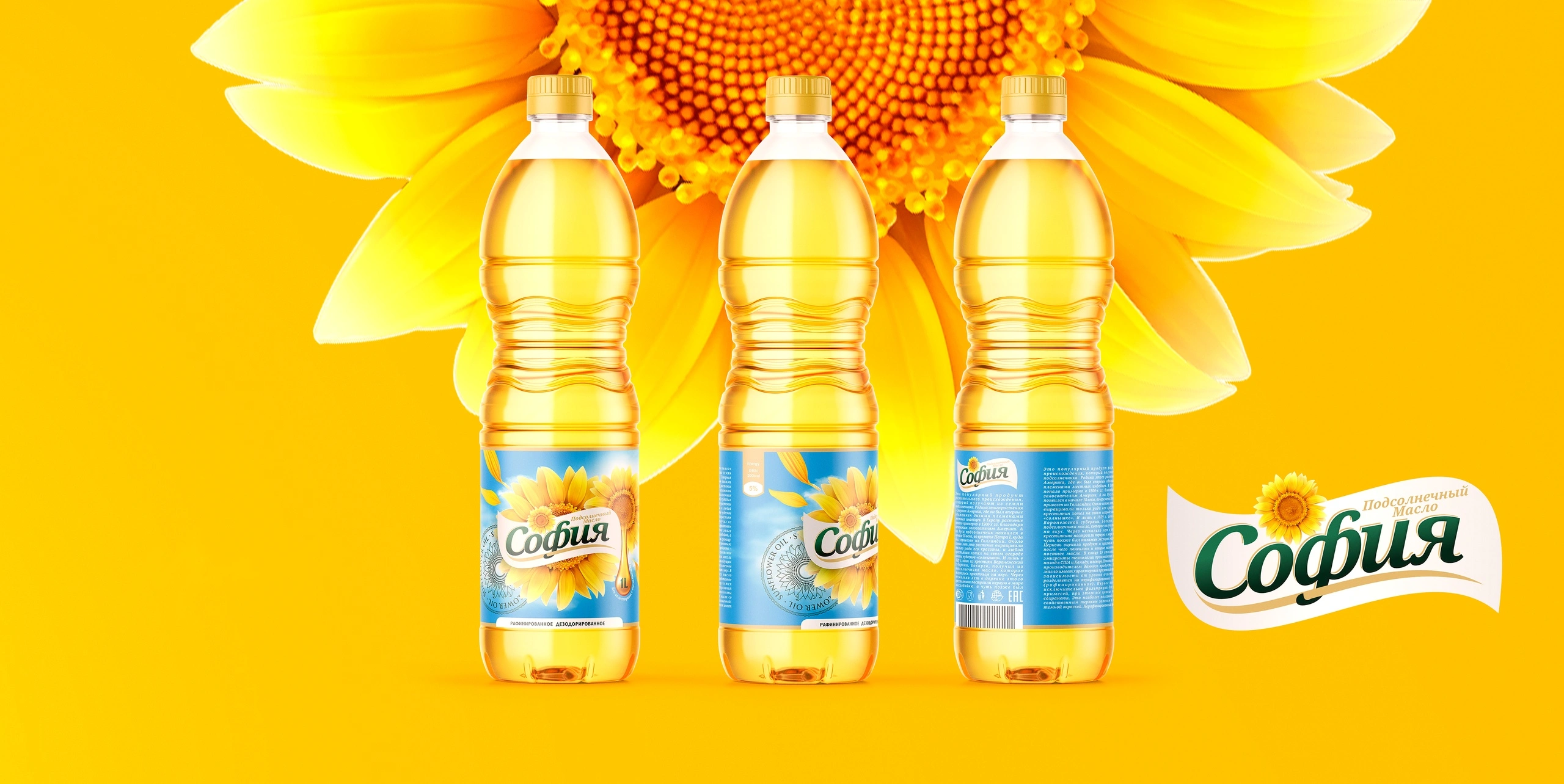
Broko: a name from family history. The Elit Konditer factory, founded by a family of brothers, made tartlets, cupcakes, brownies, doughnuts, croissants and chocolate under different names and in different designs, and shoppers did not realise it all came from one manufacturer. The name Broko — from Bro (brothers) and Co (company), "the brothers' company" — grew out of the founders' story. Analysing the small-pastry shelf led to an insight: here the winner is not the brightest pack but the most recognisable one. So the whole range is held together by one signature colour — tiffany blue against red-and-yellow competitors — and for a new product only the colour of the flavour ribbon changes. The system now has more than 15 SKUs.
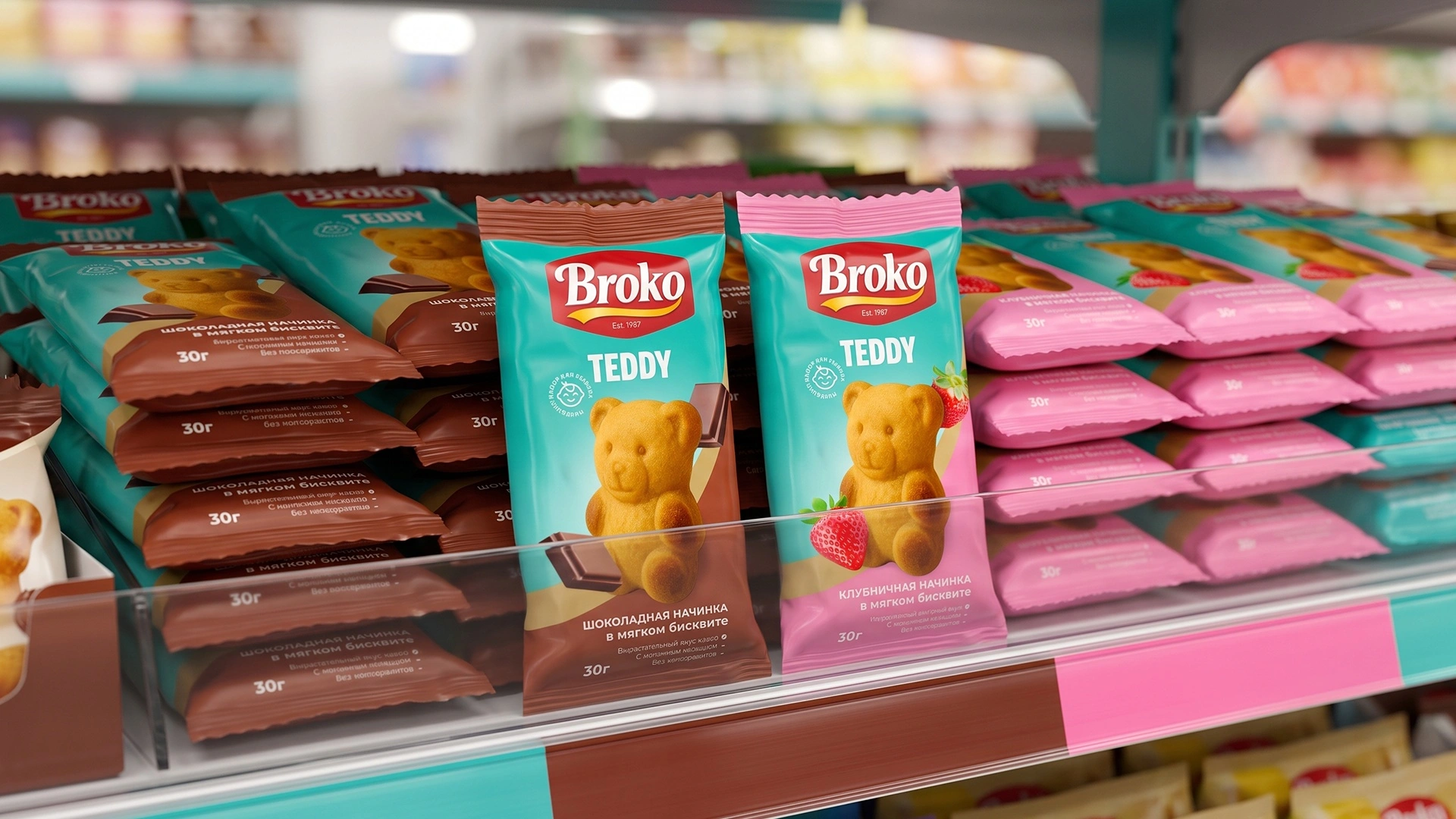
Sofia: making a shared symbol your own. Sunflower oil already has a natural symbol — the sunflower. The team decided not to invent a new image but to make this one its own: a living sunflower above the logo and a sky-blue label that contrasts with the golden oil, so that the oil's colour remains the main proof of quality. Choosing not to break the category code but to own it is a strategic decision, and it is made by a person who understands the shelf.
"AI is great at answering the question of how else this could look. But the client pays for the answer to a different question: why a shopper will pick this particular pack. That answer comes from the shelf, the brand's history and production, and it is still the designer who finds it." — Lazizkhuja Sharipov, founder and director of Minim Design
Frequently asked questions
Can AI fully replace a packaging designer?
Not yet. AI creates images quickly, but it does not build a brand strategy, design a system for a range, check labeling or prepare files for print. In T&T Design Group's 2026 study, AI-only packaging received the lowest trust score of the three versions: 4.12 points versus 5.08 for the hybrid.
Which packaging design tasks can be handed to AI?
Moodboards, quick sketches of directions, rough backgrounds and textures, mockups for presentations, images and infographics for marketplace product cards, draft descriptions. These are tasks that need many options and where mistakes are easy to spot and fix. Selection and final decisions still rest with the designer who is responsible for the result.
Can you register a trademark created by AI?
A trademark is examined for distinctiveness and for similarity to registered marks, so the main risk is similarity: the generator may have reproduced someone else's element. In addition, copyright in an image without a human creative contribution is in question. It is safer when the logo is created or substantially reworked by a designer and a database search is run before filing.
How much time does AI save in packaging work?
There is no packaging-specific data. In the 2026 Adobe and Advanis survey, creative professionals estimated the savings at 17 hours a week on average, and 94% said they work faster. In packaging, the gain falls mainly on research, sketches and mockups, while strategy, the range system and prepress shrink very little.
Should the client be told that AI was used in a project?
Yes, ideally, and it should be recorded in the contract. The client needs to know which elements were generated, who owns the rights to the final artwork, and whether their unpublished materials went into public services. This transparency helps avoid disputes during trademark registration and in case of third-party claims.
Key takeaway
AI has changed the speed of packaging work, not its essence. A moodboard, sketch or mockup now appears in hours, and there is no reason to give that up. But a generator answers the question of what a pack could look like, while the shopper at the shelf is deciding something else: why take this one. The answer comes from market insight, a range system, accurate copy in the right languages and a file that prints correctly. In the T&T Design Group study, the highest trust scores went to packaging where AI and a designer worked together. So the sensible model for a manufacturer is not AI instead of a designer, but AI in a designer's hands: generation for speed, people for decisions and responsibility.
About the author. Lazizkhuja Sharipov is the founder and director of Minim Design and has led the agency since it was founded in 2019.
About Minim Design. Minim Design is a packaging design agency from Tashkent, founded in 2019. The team has more than 20 specialists, and the agency has 1,156 completed projects and exports its services to 12 countries. Minim handles projects end to end: naming, logo, packaging design, 3D visualisation and print supervision. The agency's work has been featured by Packaging of the World, Dieline and World Brand Design Society.
Sources
- Packaging World — T&T Design Group's study "When Humans Meet Machines" on trust in AI-made packaging (02.09.2026): packworld.com
- Adobe — survey of creative professionals and marketers on AI, conducted with Advanis (17.04.2026): blog.adobe.com
- Ministry of Digital Technologies of Uzbekistan — AI Development Strategy until 2030, PP-358 of 14.10.2024: gov.uz
- Lex.uz — Law "On Copyright and Related Rights", ZRU-42 of 20.07.2006, Article 3: lex.uz
- Spot — Law ZRU-1115 on regulating artificial intelligence (21.01.2026): spot.uz
- U.S. Copyright Office — report "Copyright and Artificial Intelligence, Part 2: Copyrightability" (29.01.2025): copyright.gov
Share

Other articles
25.11.2026
New Uzbek Alphabet: Old Labels Allowed Until 2029
Manufacturers will not have to throw away packaging that is already printed because of the alphabet change. Below is what this means for manufacturers, designers and printers.
24.11.2026
Gen Z in Uzbekistan: How Packaging Sells to 8.5 Million Young Shoppers
A 19-year-old shopper first sees your packaging not on the shelf but on a phone: in a friend’s story, in a Uzum Market product card or in a short unboxing video. Below we look at how young shoppers behave at the shelf, which packaging techniques work on them and where brands go wrong when they make a product “for young people”.
20.11.2026
An Imported Brand on Uzbekistan’s Shelves: What to Change in Packaging and Labeling
An imported product can clear customs without a single word of Uzbek — and still get stuck on its way to the shelf. Below is what must appear on imported packaging, when a sticker is enough and when you need your own print run, and what in the design is best left alone.