


20.11.2026
An Imported Brand on Uzbekistan’s Shelves: What to Change in Packaging and Labeling

An imported product can clear customs without a single word of Uzbek — and still get stuck on its way to the shelf. Uzbekistan requires brands to speak to shoppers in the state language, and in 2025 some familiar labeling rules changed: many label templates online still cite a document that is no longer in force. Below is what must appear on imported packaging, when a sticker is enough and when you need your own print run, and what in the design is best left alone.
In short. In Uzbekistan, product information must be given to shoppers in the state language — the consumer protection law requires it. For imported packaging this means Uzbek text in Latin script, details of the manufacturer, importer and country of origin, and for some categories, space for an Asl belgisi code. It is cheaper to build all of this into the design before printing than to add a sticker afterwards.
What language must an imported product label be in?
The state language, which is Uzbek; other languages may be added. Article 6 of the Law on Consumer Rights Protection No. 221-I of 26.04.1996 requires product information to be given in the state language and allows it to be duplicated in other languages (lex.uz). Article 21 of the Law on the State Language says the same about tags, instructions and labels (lex.uz).
It is best to choose the script right away. For goods on the Cabinet of Ministers list, Presidential Decree No. UP-140 of 15.08.2023 explicitly requires the Uzbek Latin script (UzDaily, 17.08.2023). For everything else, Latin is the safe default because it is the main official alphabet.
There is a purely commercial argument too. According to the 2026 census, Uzbek is the main language of communication for 91.3% of the country's residents and 84.7% of Tashkent residents (census results, stat.uz). Russian text, familiar to importers from CIS countries, remains a useful second language, especially in the capital, but it cannot replace Uzbek.
Can you import goods without Uzbek text and add a sticker later?
You can import them, but paperwork and shelf placement can get complicated. Uzbek-language labeling is not needed for customs clearance, but since 1 January 2024, under Decree UP-140, goods on the approved list do not receive a certificate of conformity or a sanitary-epidemiological conclusion until the manufacturer, its representative or the importer applies Uzbek labeling in Latin script. Exceptions are goods without consumer packaging and imports for personal use (Dairynews, 18.08.2023). The importer may apply the labeling itself (Dairynews, 25.08.2023).
An important caveat: some procedures have been simplified since then. In 2025 it was decided to abolish mandatory laboratory-based certification of food products until the end of the year (UzDaily, 21.04.2025). So check the list and procedure for your category as of the import date. The consumer law requirement, however, has not gone anywhere.
A translation sticker is a workable tool for the first batch, but it has three weak points:
- It covers other information. A sticker can easily hide the original ingredients, date or barcode.
- It peels off. In fridges, in the cold and in transit the edges lift, and the shopper sees a product with a torn label.
- It looks temporary. Next to local brands where Uzbek text is built into the design, a sticker hints that the product is only passing through.
If a brand plans to sell in Uzbekistan for more than one season, a separate print run or a multilingual version of the packaging usually pays off better.
What must appear on imported product packaging?
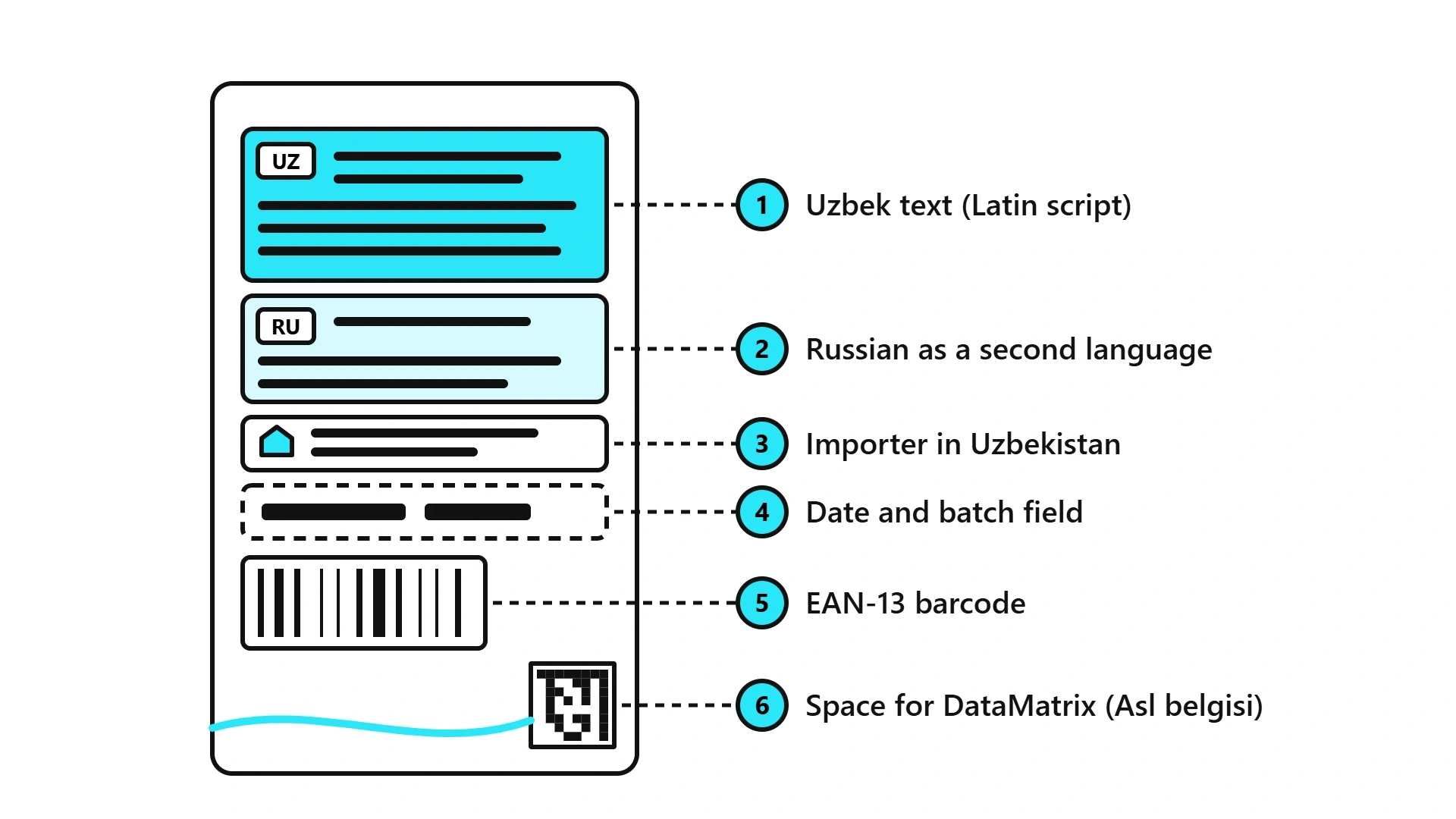
The minimum is set by Article 6 of the consumer protection law: product name, manufacturer and address, importer, country of origin, dates, and storage and usage instructions. Everything else depends on the product category.
| What to include | Basis | What to check in the artwork |
|---|---|---|
| Product name in Uzbek | Law No. 221-I, Art. 6 | The product type is translated; the brand name can stay in Latin script |
| Manufacturer: full name and address | Law No. 221-I, Art. 6 | Full address, with the country also named in Uzbek |
| Importer in Uzbekistan | Law No. 221-I, Art. 6 | If there are several importers, leave a field for an importer sticker |
| Country of origin | Law No. 221-I, Art. 6 | Identical in every language block |
| Production date, shelf life, storage conditions | Law No. 221-I, Art. 6 | A high-contrast field for the date coder, referenced from the back panel |
| Ingredients, nutrition facts, allergens (for food) | Sanitary rules for the category | Figures and ingredient order are the same in all languages |
| EAN-13 barcode | Checkouts and inventory systems read the product by it | Dark bars on a light background, not on a fold and not under a sticker |
| Asl belgisi code | For categories with digital labeling | Free space for a DataMatrix code |
| Halal mark | Only with a valid certificate | The certificate covers this specific product (about halal certification) |
Which labeling rules apply now, and what changed in 2025?
The main change: the general technical regulation on food labeling is no longer in force. Cabinet of Ministers Resolution No. 490 of 12.07.2017 became invalid on 2 September 2025 (lex.uz). Even earlier, from 1 August 2025, technical regulations and standards for food products stopped being mandatory, and oversight passed to the Committee for Sanitary and Epidemiological Welfare and Public Health, which is preparing sanitary rules (Upl.uz, 28.07.2025).
The practical consequence: many checklists and label templates still cite Resolution No. 490. The information itself — ingredients, nutrition facts, allergens, dates — is still needed by shoppers and retail chains, but you can no longer cite clauses of the old regulation. Before printing, check the current sanitary rules for your category on lex.uz.
A separate layer is Asl belgisi digital labeling. It is currently mandatory for alcohol and tobacco, beer, some household appliances, medicines, water and soft drinks. Mandatory traceability for water and drinks has been postponed to 1 April 2027, but imported drinks already arrive with aggregated codes. From 1 January 2028, labeling becomes mandatory for dietary supplements (Spot.uz, 08.07.2026; the list is also given by trade.gov, 09.12.2025). For designers the takeaway is simple: space for a DataMatrix code is planned into the artwork in advance.
What to change in the design, and what to keep as it is?
Change the language and the information layer, not the face of the brand. The logo, brand colour, pack shape and key visual are distinctive assets that let people recognise the brand without reading, and they work in any market. The brand name usually stays in Latin script as well. Everything the shopper reads is what needs reworking.
- Check how the name sounds. How the brand sounds in Uzbek and Russian, and whether there are unfortunate associations or hard-to-read letter combinations.
- Write the Uzbek text from scratch. The product name, flavour and claims on the front are written by a native speaker, not a machine translator: a literal translation from Russian or English sounds bureaucratic and sometimes changes the meaning.
- Rebuild the hierarchy. On the front: brand, product type in Uzbek and flavour. On the back: language blocks always in the same order, so the eye finds its own at once.
- Check the typeface. The font must support the letters oʻ and gʻ and the ʼ sign, otherwise straight apostrophes or empty boxes will go to print.
- Keep the technical fields. Importer, date and batch, barcode, DataMatrix — each needs its own place that a sticker or a seam will not cover.
- Check the figures line by line. Weight, nutrition facts, dates and storage temperature must match in every language down to the last comma.
How to prepare multilingual files for the printer so you do not pay for a reprint is covered in our article on preparing artwork for print. If the product will sell through a marketplace, the article on packaging for Uzum Market will also help: the product card has to speak Uzbek too.
What does multilingual packaging look like in practice?
Minim has no public case of an imported brand entering Uzbekistan, but it does have the reverse tasks: local and neighbouring brands that design packaging for several markets at once. The logic is the same.
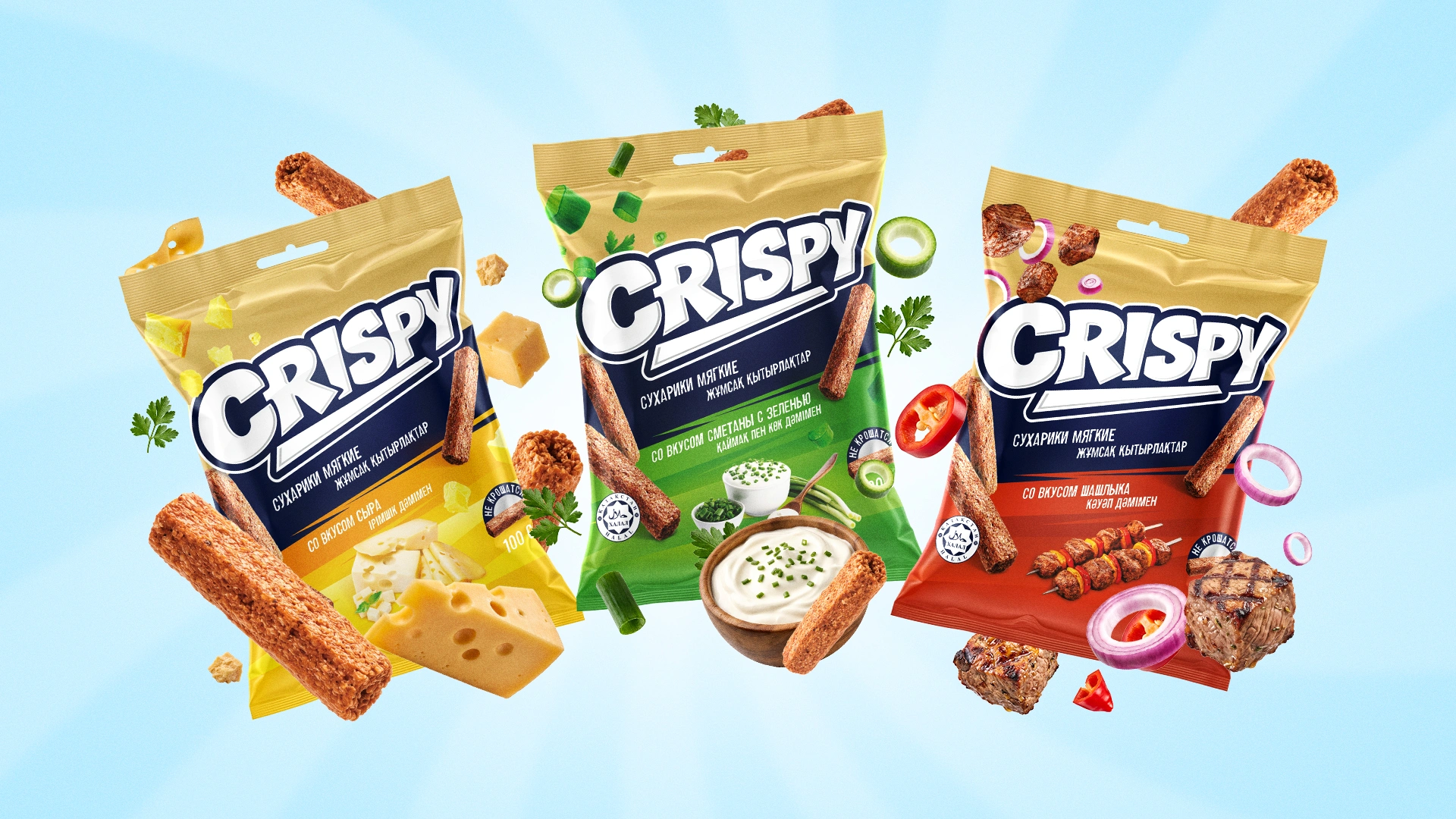
Crispy: five languages on one back panel. Baraka N1 from Shymkent commissioned a soft crouton brand for the Kazakhstan market. At the client's request, Russian became the main language, and the back panel is in Kazakh, Uzbek, Kyrgyz, English and Arabic. The product and flavour names on the front are given in Russian and Kazakh, and the nutrition table combines five languages. The name Crispy was chosen because it is easy to read and understand in Russian, Kazakh and English. The first wave had 12 SKUs, and it took about four months from brief to print-ready files.
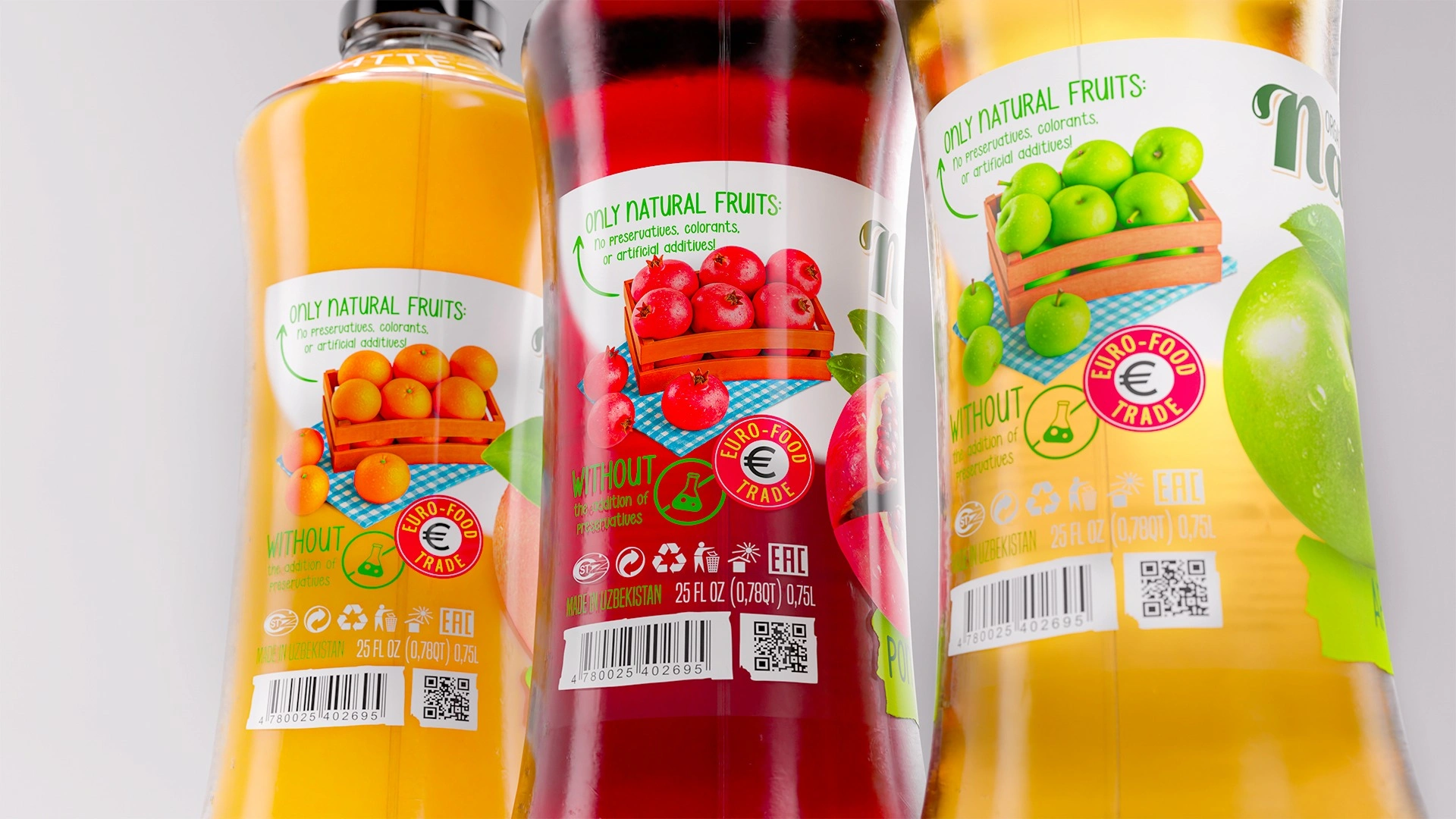
Natte: a name built for several countries. Euro Food Trade is launching natural juices first in Uzbekistan, then in Kazakhstan and for export. That is why the brief called for a 4–5 letter name that is easy to pronounce in all these markets. The short name Natte plays on the word natural and passed the trademark check, and the label carries “Made in Uzbekistan”.
An imported brand in Uzbekistan needs the same scheme, only in reverse: the name and visual assets stay, while the language and information layer are built for the local shopper.
“Translation is the last step, not the first. First we decide what the shopper should read in Uzbek on the shelf in three seconds, and only then do we spread everything else across the languages.” — Lazizkhuja Sharipov, founder and director of Minim Design
Frequently asked questions
Is an Uzbek-language label mandatory for imported products?
Yes. The Law on Consumer Rights Protection No. 221-I requires product information to be given to the shopper in the state language; other languages are allowed in addition. For goods on the Cabinet of Ministers list, a certificate of conformity and a sanitary-epidemiological conclusion are not issued without Uzbek labeling. Customs does not require such labeling, but selling the product without it is risky.
Should Uzbek text on packaging be in Latin or Cyrillic script?
Latin. Decree No. UP-140 of 15.08.2023 requires labeling in the Latin script of the Uzbek alphabet for goods on the Cabinet of Ministers list. For other goods Latin is also the safe choice, as it is the main official alphabet. Make sure the font supports the letters oʻ and gʻ and the ʼ sign, otherwise straight apostrophes will go to print.
Can imported goods be sold with a translation sticker?
Yes, the importer can apply the Uzbek labeling itself, and a sticker is the usual approach for the first batch. But the sticker must not cover the original ingredients, date or barcode, and it must stay on for the entire shelf life. If a brand sells in Uzbekistan for longer than a season, a separate print run or multilingual packaging usually pays off better and looks more reliable on the shelf.
Is Cabinet of Ministers Resolution No. 490 on food labeling still in force?
No. Resolution No. 490 of 12.07.2017 became invalid on 2 September 2025, and from 1 August 2025 technical regulations for food products stopped being mandatory. Oversight passed to the Committee for Sanitary and Epidemiological Welfare. Before printing, check the current sanitary rules for your category on lex.uz.
Does an imported product need an Asl belgisi code?
It depends on the category. Digital labeling is mandatory for alcohol, tobacco, beer, some household appliances, medicines, water and soft drinks, and it becomes mandatory for dietary supplements from 1 January 2028. Imported drinks already arrive with aggregated codes. Even if your category is not on the list yet, it is better to leave space for a DataMatrix code in the artwork.
Key takeaway
Customs will let a product through without Uzbek text, but shoppers, retail chains and inspectors will read the packaging in Uzbek. That is why localisation starts not with a translator but with a decision about what the shopper must understand on the shelf in a few seconds. The brand's logo, colour and shape move across unchanged, while the language, importer information and technical fields are built for Uzbekistan. The rules here change quickly: Regulation No. 490 has been repealed, technical regulations have become voluntary, and digital labeling is expanding. A sticker will rescue the first batch, but a long life on the shelf comes from packaging where Uzbek text is not a sticker but part of the design.
About the author. Lazizkhuja Sharipov is the founder and director of Minim Design and has led the agency since it was founded in 2019.
About Minim Design. Minim Design is a packaging design agency from Tashkent, founded in 2019. The team has more than 20 specialists, and the agency has completed 1,156 projects and exported its services to 12 countries. Minim runs projects end to end: naming, logo, packaging design, 3D visualisation and print supervision. The agency's work has been featured by Packaging of the World, Dieline and World Brand Design Society.
Sources
- Lex.uz — Law on Consumer Rights Protection No. 221-I of 26.04.1996, Article 6: lex.uz
- Lex.uz — Law on the State Language, Article 21 on tags and labels: lex.uz
- Lex.uz — Cabinet of Ministers Resolution No. 490 of 12.07.2017, invalid since 02.09.2025: lex.uz
- UzDaily — Decree No. UP-140 and Latin-script labeling (17.08.2023): uzdaily.uz
- Dairynews — no sanitary conclusion without state-language labeling, exceptions (18.08.2023): dairynews.today
- Dairynews — importers apply Uzbek labeling themselves (25.08.2023): dairynews.today
- UzDaily — abolition of mandatory food certification (21.04.2025): uzdaily.uz
- Upl.uz — technical regulations for food not mandatory from 1 August 2025 (28.07.2025): upl.uz
- Spot.uz — Asl belgisi digital labeling categories and deadlines (08.07.2026, sponsored): spot.uz
- U.S. International Trade Administration — labeling and marking requirements in Uzbekistan (09.12.2025): trade.gov
- 2026 population census results — languages of communication: stat.uz, PDF
Share

Other articles

19.11.2026
Snack and Sunflower Seed Packaging Design: How to Win the Impulse Purchase
Hardly anyone puts a bag of chips or sunflower seeds on a shopping list. Below we look at why snacks are bought on impulse, how to stand out in a category where all the bags look alike, what must read on the front of the pack and how these tasks were solved in Minim's snack projects.

13.11.2026
From Loose Goods to a Brand: How a Producer Moves from Wholesale to Retail
At the bazaar, rice from one sack is no different from rice in the next: shoppers compare the price per kilo and buy from whoever gives a better deal. Below: where to start, which channel to choose first, what must be on the pack, and how not to overpay for your first product line.

13.11.2026
Confectionery Packaging Design: Wafers, Sweets and Biscuits
A pack of wafers is taken off the shelf in a couple of seconds, and shoppers rarely compare ingredients. Below we look at how confectionery packaging design differs for wafers, sweets and biscuits, how to show flavour through film, when a window is needed, and how to keep a range of a dozen flavours in order.