


10.11.2026
Packaging Design Development Stages: How the Minim Agency Works
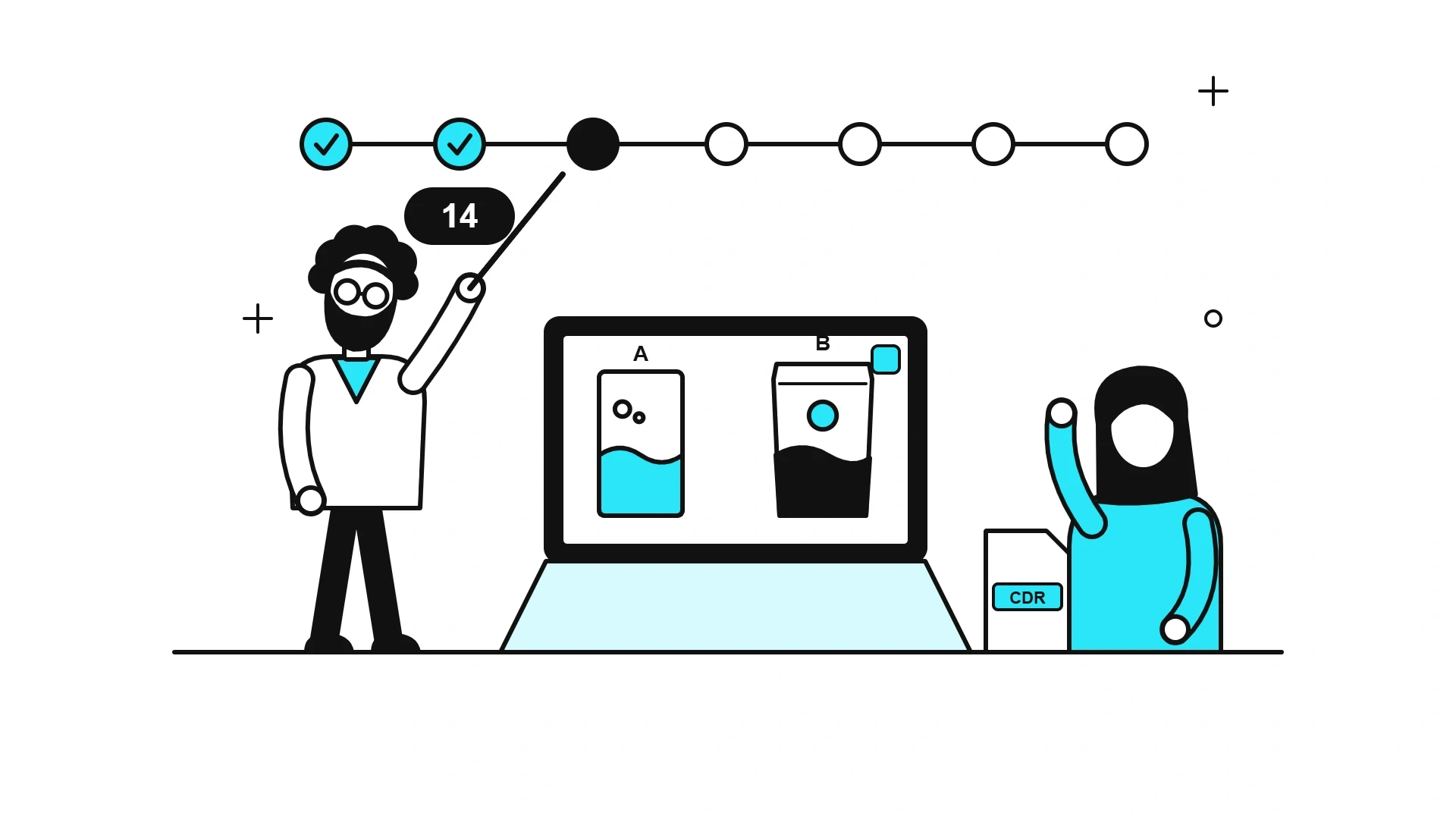
Before ordering packaging design, a manufacturer wants to know three things: how long it will take, what they will see and at what point they can influence the result. Below is the full path of a project at the Minim agency, from the first online meeting to supervising the print run at the printer. And an explanation of why the result matters to us as much as it does to the client.
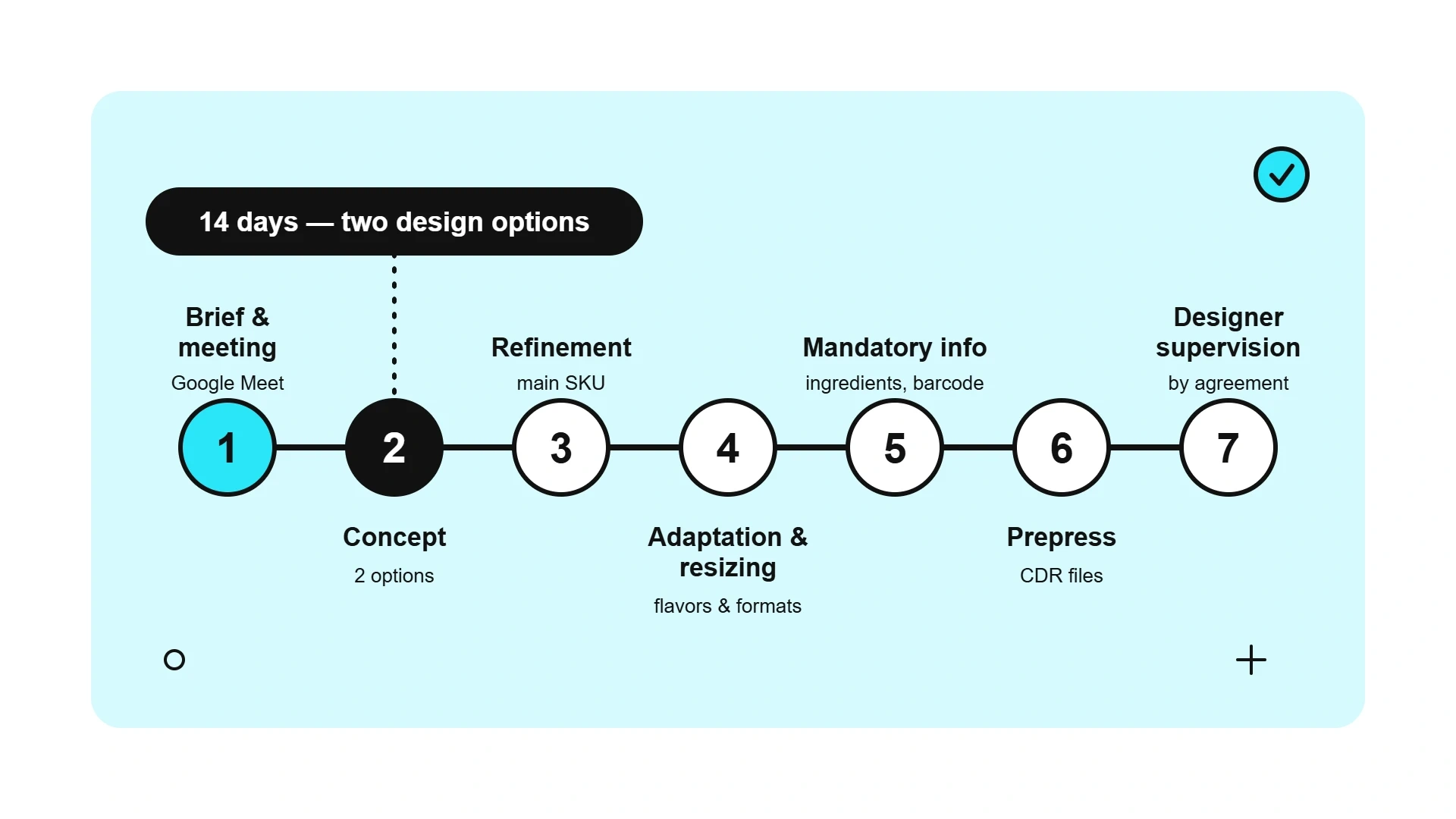
In short. A project at Minim goes through seven stages: a brief and an online meeting in Google Meet, the concept, refinement of the chosen option, adaptation to flavors and formats, layout of mandatory information, prepress and, by agreement, designer supervision at the printer. We prepare a concept with two design options in 14 days and hand over print-ready source files in CDR format.
What stages does packaging design development consist of?
Seven stages, and at each of them the client receives a clear result that can be discussed and approved.
| Stage | What happens | What the client gets | Timing |
|---|---|---|---|
| 1. Brief and meeting | We discuss the task in Google Meet, fill in the brief and estimate the scope | A commercial proposal and a contract | Before work starts |
| 2. Concept | We study the shelf and competitors, look for an idea and develop two options | Two design options as visualizations | 14 days |
| 3. Refinement | We polish the chosen option based on comments | An approved layout of the main SKU | Per project |
| 4. Adaptation and resizing | We carry the design over to flavors, the range and other formats | Layouts for the whole range | Estimated separately |
| 5. Mandatory information | We place the ingredients, labeling marks and barcode | Layouts with all sides of the pack | Per project |
| 6. Prepress | Color modes, Pantone, masks for varnish and foil | Print-ready source files in CDR | Per project |
| 7. Designer supervision | Checking the color proof and first sheets at the printer | A color proof and first sheets checked by the designer | By agreement |
How does a project start?
With an online meeting in Google Meet and a brief. At the meeting we look at the business task: what the product is, who buys it, which shelf it will stand on, who it competes with and at what price it sells. The brief covers the product matrix, sales markets, price segment, USP (unique selling proposition) and style preferences. After that we estimate the scope and send a commercial proposal with timing and cost, and work begins once the contract is signed and the advance payment is made.
Meetings are held online, so it does not matter where production is located: in Tashkent, in the regions or abroad. Why marketing decisions should be made before design is explained in detail in our article on strategy before packaging design.
What is included in the concept and why are there two options?
The concept is the idea of the packaging shown in two design options, and it takes us 14 days. During this time the team studies the shelf and competitors, looks for an insight about the shopper and turns it into two different visual solutions. We show each option as a visualization close to the real packaging, so that it is clear how it will look on the shelf.
Two well-thought-out options are easier to compare and discuss than many superficial ones: the choice becomes a choice of strategy, not a sorting of pictures. The client chooses one option, and we move forward with it. The concept presentation also takes place in Google Meet, so everyone on the client’s side who makes the decision hears the logic of each option first-hand.
How is the chosen option refined?
We bring the chosen option to a finished layout on one main SKU (stock keeping unit). Illustrators finish patterns, illustrations and characters, designers fine-tune colors, fonts and composition, and the copywriter prepares the texts for the front. At the same time we allocate the zones: where the brand, the food zone, the mandatory information and the barcode will go.
We make revisions based on the client’s comments. The result of this stage is an approved layout that becomes the reference for the whole range. The rights to the design pass to the client under the terms of the contract.
What are flavor adaptation and resizing, and how are they priced?
Adaptation means carrying the approved design over to other flavors and items in the range; resizing means carrying it over to other sizes and formats of packaging. We estimate both separately for each project.
- Flavor adaptation. We build color coding so the shopper finds the right flavor at once, and transfer the texts and the rules by which the range can keep growing.
- Resizing. We rebuild the composition for another size or shape: from a box to a doypack, from a small pack to a family pack. This is not scaling a picture: on a different shape the proportions, zones and readability change.
- Why the price varies. Carrying the design over to a new flavor in the same box and rebuilding a layout from a vertical jar to a horizontal bag are tasks of different scope, so there is no single price per SKU.
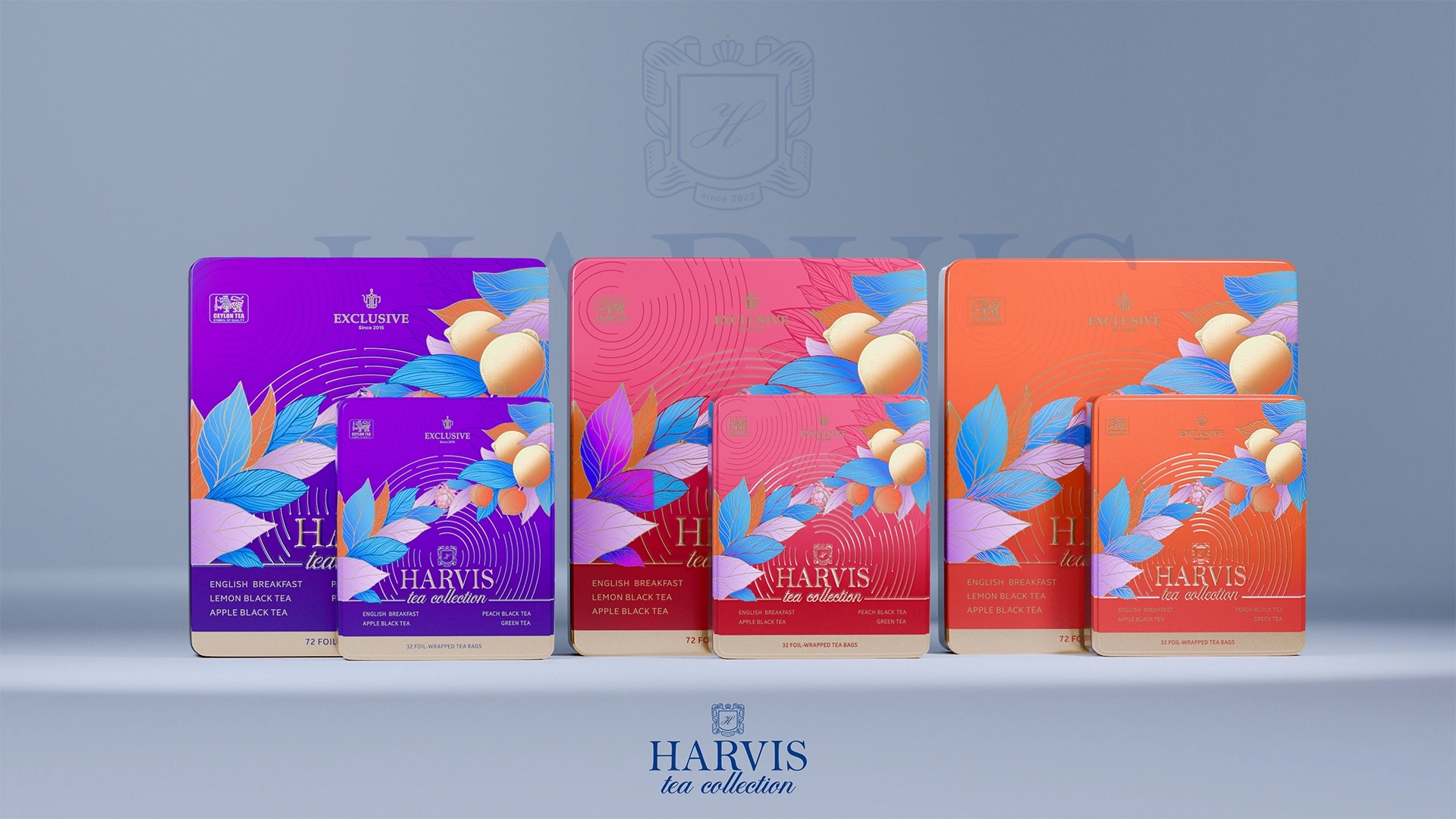
The dielines for adaptation are provided by the client or their packaging manufacturer. A well-thought-out system works for a long time: for example, after the first project for Exclusive Harvis tea, the client came back to Minim with an order for 10+ more SKUs.
How is the mandatory information placed?
Once the design is approved, we lay out the ingredients, dates, labeling marks and barcode on all sides of the pack. The text is provided by the manufacturer; we proofread it for obvious errors, distribute it across the dieline, watch the readability of the font and place the marks and barcode in the right zones. The final proofreading is done by the client’s food technologist: they are responsible for the accuracy of the product data and sign off the layouts.
In what form does the client receive the files?
We hand over print-ready source files in CDR format, the format of the CorelDRAW graphics editor. Before handover, the files go through prepress:
- the color mode is chosen for the printing technology;
- brand colors are assigned Pantone numbers;
- separate masks are made for varnish, foil and embossing;
- text is converted to curves, and images are brought to the required resolution.
Which effects can actually be printed in Uzbekistan and which will require compromises is covered in our article on printing technologies.
What is designer supervision and when is it needed?
Designer supervision is the designer’s control at the production site: they compare the color proof and the first sheets of the run with the approved layout and resolve disputed questions about color and finishing together with the printer. We carry it out by agreement with the client.
It is especially needed when the design has complex finishing — foil, embossing, spot varnish — when the brand color is critical for recognition, or when the client is working with a printer for the first time. In the Exclusive Harvis project, the Minim team led the work from the shape of the packaging to print and agreed technical details directly with manufacturers in China.
Why does the client’s success matter to the agency?
Because our reputation depends on it: if the client’s product has confidently entered the market, people learn about Minim as an agency that makes packaging that sells. That is why we look at a project not as a layout but as a product that has to sell. According to the agency, 95% of clients come back to us with new tasks — and for us this is the main sign that the packaging worked.
Research also confirms the link between design and money. In McKinsey’s 2018 study, which analyzed 300 listed companies over five years, those in the top quartile for design practice grew revenue 32 percentage points faster than competitors in their industry (McKinsey). How to measure the effect of packaging in your own business is covered in our article on measuring redesign effectiveness.
“Our best result is when a client comes back with their next product. It means the packaging worked on the shelf, not just looked good in the presentation.” — Lazizkhuja Sharipov, founder and director of Minim Design
Frequently asked questions
How long does packaging design development take?
We prepare a concept with two design options in 14 days. The total project time depends on the number of SKUs and formats, the number of revisions and whether layout of mandatory information and designer supervision are needed. We fix the exact schedule in the commercial proposal after the brief.
How many design options do you show?
In the concept we show two design options, each as a visualization close to the real packaging. The client chooses one, and then we refine it based on comments. Two well-thought-out options are easier to compare and discuss than many superficial ones, and the presentation takes place online in Google Meet.
How are flavor adaptation and resizing priced?
Separately and for the specific project: the amount of work depends on how many flavors and formats the range has and how different they are. Carrying the design over to a new flavor in the same box is easier than rebuilding the composition for a different packaging shape, so there is no single price per SKU. We name the cost after we have seen the product matrix.
In what format do you hand over source files?
We hand over print source files in CDR (CorelDRAW) format, already prepared for print: with the color mode chosen, Pantone numbers for brand colors, masks for varnish and foil, and text in curves. The client receives the source files, and from there they go to the printer.
Can you work with Minim remotely?
Yes. Meetings take place online in Google Meet: there we discuss the brief, present the concept and agree on revisions. Layouts and files are transferred electronically, so the location of production does not matter. The agency already exports its services to 12 countries.
What is designer supervision of packaging printing?
It is the designer’s control at the production site: they compare the color proof and the first sheets of the run with the approved layout and resolve disputed questions about color and finishing together with the printer. We carry out designer supervision by agreement with the client, and it is especially useful with complex finishing and on the first run.
Key takeaway
A good process does not make the design more beautiful by itself, but it removes surprises: the client knows in advance when they will see the concept, what they will receive at each stage and in what form the files will go to the printer. For us this means 14 days for a concept with two options, separate estimates for adaptation and resizing, meetings in Google Meet, source files in CDR and designer supervision by agreement. But the main thing is something else: we work not to hand over a layout, but to launch a product. As the Uzbek saying goes, “Kemaga tushganning joni bir” — those in the same boat share one fate. A client’s successful launch is the best advertisement for the agency.
You can discuss your project at an online meeting: +998 97 400-04-13, info@minim.uz, t.me/minim_design.
About the author. Lazizkhuja Sharipov is the founder and director of Minim Design and has led the agency since its founding in 2019.
About Minim Design. Minim Design is a packaging design agency from Tashkent, founded in 2019. The team has more than 20 specialists, and the agency has 1,156 completed projects and exports its services to 12 countries. Minim runs the entire project: naming, logo, packaging design, 3D visualization and print control. The agency’s work has been featured by Packaging of the World, Dieline and the World Brand Design Society.
Sources
- McKinsey — The Business Value of Design study (25.10.2018): mckinsey.com
- Minim Design — Exclusive Harvis case study: minim.uz
- Minim Design — agency data on projects and clients: minim.uz
Share

Other articles
10.11.2026
The Food Zone on Packaging: Photo, 3D or Illustration?
The food zone is often chosen by the designer’s taste or by the photo-shoot budget, although the decision should be made by the product, the range and the promise the packaging makes to the shopper. Below is how to match the technique to the task, where each one is weak and how not to promise more with the picture than is in the pack.
10.11.2026
Packaging for Uzum Market: How to Sell from the Screen and After Delivery
A shopper on Uzum Market only holds the packaging after they have paid. Below is what changes in packaging design when the main sales channel is a marketplace.
10.11.2026
How Much Does Packaging Design Cost in Uzbekistan and How to Choose a Contractor
“How much does packaging design cost?” is a question whose honest answer is “it depends,” which is exactly why it is irritating. Below is what the price is made of, how to compare quotes, what to put in the contract and how to choose a contractor.