


11.11.2026
Short runs and digital packaging printing: when they pay off
The most expensive packaging is the packaging sitting in a warehouse. Many manufacturers know the scenario: to get a low unit price, they order a year's worth of packaging, and six months later the recipe, weight or design changes and the leftover stock is written off. Digital printing offers the opposite logic: each unit costs more, but the brand prints only as much as it will sell before the next change. Below: how digital differs from offset and flexo, how to calculate the break-even point between them, when a short run pays off and how to prepare the design for it.
In short. Short runs and digital printing pay off when demand has not been tested yet, there are many versions or the packaging will soon change: a product launch, a seasonal series, a range of dozens of SKUs. Digital printing needs no printing plates, so make-ready is cheaper and faster, but each unit costs more than in offset or flexo. The break-even point is calculated on the total cost: plates, make-ready, unit price, storage and write-off risk.
How is digital printing different from offset and flexography?
The main difference is that digital printing needs no plates: the image goes onto the material straight from the file. Make-ready is therefore shorter and switching versions is faster. In offset and flexo, plates are made for every artwork, and their cost is spread over the run: the bigger the run, the cheaper each unit (Esko, 22.09.2026). The downside of digital, according to the same review, is noticeably more expensive inks and a narrower choice of materials. That is why traditional methods usually win on long runs.
| Parameter | Digital printing | Offset | Flexography |
|---|---|---|---|
| Printing plates | Not needed | For every artwork | For every artwork |
| Unit price on a short run | Usually lower | High: plates are split over few units | High for the same reason |
| Unit price on a long run | Barely falls | Falls as the run grows | Falls as the run grows |
| Versions and variable data | Every copy can be different | New version — new plates | New version — new plates |
| Typical use | Labels, cartons, flexible packaging, corrugated boxes | Folding cartons, labels | Flexible film packaging, self-adhesive labels, kraft |
Which finishes can actually be printed in Uzbekistan is covered in our article on printing technologies.
Digital packaging printing is growing fast but remains a niche. Smithers estimates that the global market for digital printing of packaging and labels will grow from 22.0 billion dollars in 2025 to 36.9 billion in 2030 (Smithers). Yet in 2025 digital accounted for only 1.3% of printed packaging by volume and 4.1% by value (FTA, 14.11.2025). The gap between these shares describes digital's place precisely: it prints little, but each impression costs more.
How do you calculate the run length at which offset or flexo becomes cheaper?
The break-even point is the run at which plates and make-ready are paid back by the lower unit price. But the decision should be based on total cost: add storage, money tied up in stock and write-off risk to the quote.
- Two quotes. Ask the printer to price the same artwork, material and finish in digital and offset (or flexo) for several run lengths, for example 1,000, 3,000 and 10,000 units.
- Fixed part. Separate what does not depend on the run: plates and make-ready. A cutting die is often needed for any printing method, so compare it separately.
- Break-even point. Divide offset's fixed costs by the difference in unit price.
- Total cost. Add storage, money in stock and the risk of an early packaging change, and compare the result with how much the brand can confidently sell before the next change.
Illustrative example. The figures are made up for illustration and are not printers' prices. Suppose offset plates and make-ready cost 3,000,000 soums, an offset unit costs 500 soums and a digital unit 1,500 soums with no plate costs. The break-even point is 3,000,000 / (1,500 − 500) = 3,000 units: below it digital is cheaper, above it offset. Now assume the brand sells 2,000 boxes a month.
| Scenario (illustrative) | Printed, units | Cost, soums | Per box sold, soums |
|---|---|---|---|
| Testing a new flavour digitally | 1,500 | 2,250,000 | 1,500 |
| The same test in offset | 1,500 | 3,750,000 | 2,500 |
| Annual offset run, design unchanged | 24,000 | 15,000,000 | 625 |
| Annual offset run, design changed after six months | 36,000 | 24,000,000 | 1,000 |
| Two six-month offset runs | 24,000 | 18,000,000 | 750 |
| Digital every month | 24,000 | 36,000,000 | 1,500 |
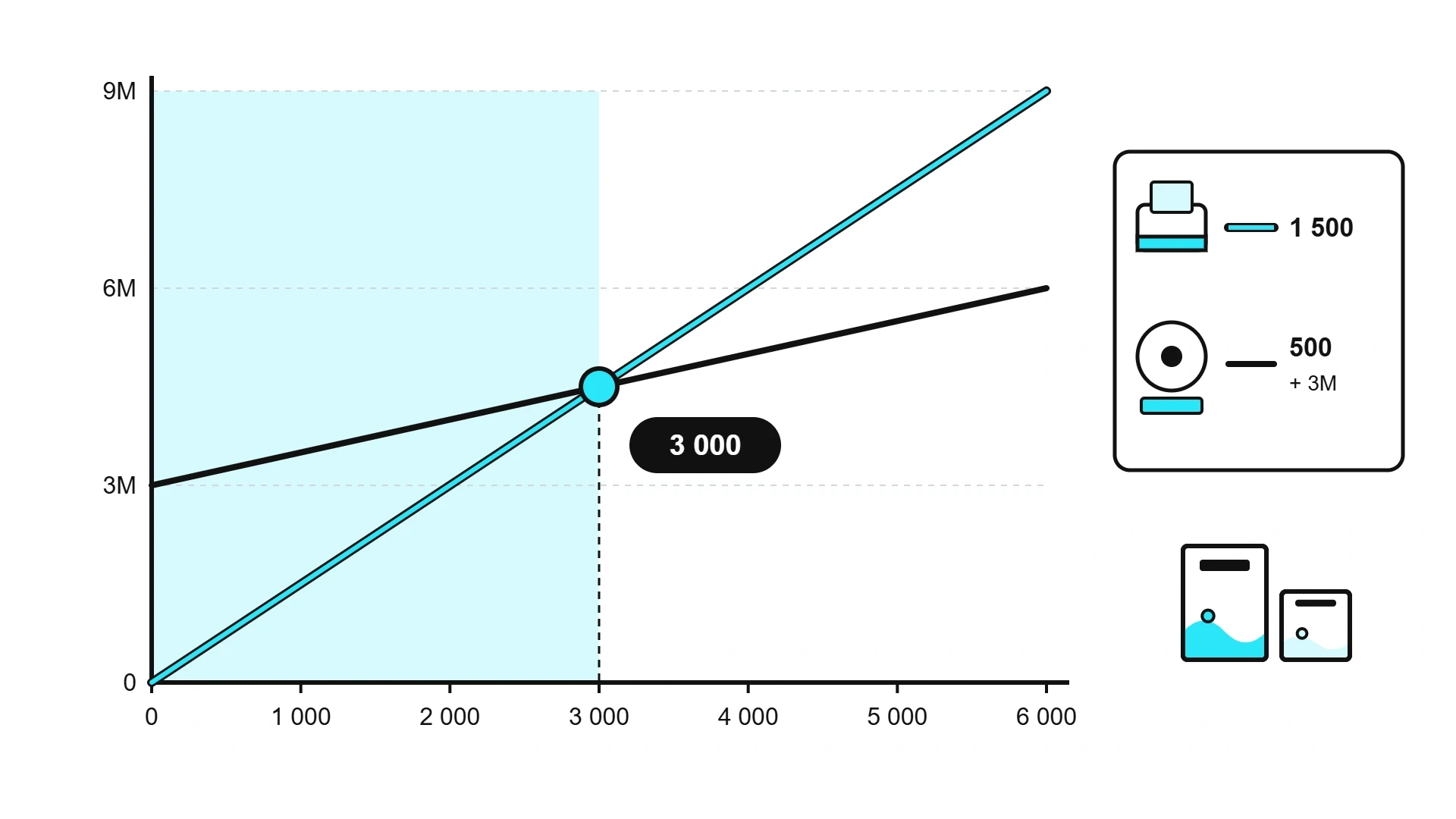
The lowest price in the quote, 625 soums per box for an annual run, turns into 1,000 soums if the design changes halfway and 12,000 boxes are written off. Digital wins only in the test, where fewer than 3,000 units are needed before the next change; for a stable product, monthly digital printing costs twice as much as six-month offset runs. The takeaway: packaging is ordered not "for a year" but for the period during which it definitely will not change.
When is a short run better than a long one?
A short run is better when the brand cannot say with confidence how much packaging it will sell before the next change. Most often there are five such situations:
- Launch and demand testing. The first batch of a new product is printed for a trial delivery to a few stores or a marketplace. If the product does not take off, the brand loses a small run, not a warehouse full of boxes.
- A range with many SKUs. Every flavour and format has its own demand, and some items sell less than the break-even quantity. Digital needs no plates for each version, while in offset the printer can gang several items on one sheet.
- Seasonal series. Holiday packaging sells for a few weeks, and leftovers barely sell after the holiday.
- Upcoming changes. A new recipe, weight, certificate, retail chain requirements or a new regulation.
- Variable data. Batch numbers, unique QR codes, texts for different markets: digital makes every copy different without new plates (Esko).
A recent example of a rule that changes packaging regardless of the brand is the alphabet reform. On 21 October 2026, Law No. ZRU-1184 was signed: in the Uzbek Latin alphabet, oʻ, gʻ, sh and ch will be replaced by ö, ğ, ş and ç (gov.uz). The law takes effect on 22 April 2027; it sets no deadlines for replacing labels, and the Cabinet of Ministers is to approve a transition programme within two months (lex.uz). Still, packaging with Uzbek text printed now for a year ahead will meet the new rules while still in circulation. Which fonts already support the new letters is covered in our article on fonts for Uzbek Latin and Cyrillic.
Meanwhile, the number of young brands is growing. According to the National Statistics Committee, as of 1 October 2026 there were 621.1 thousand active enterprises and organisations in Uzbekistan, 13.1% more than a year earlier; 459.1 thousand of them, or 73.9%, are small businesses and micro-firms. In January–September 2026, 68,480 new enterprises were created (UzDaily, 16.10.2026). A new brand rarely knows its demand in advance, and the question of run length arises with the very first batch.
When is digital printing not the right choice?
Digital loses on long stable runs and where colours, effects or materials are needed that it reproduces less well.
- Large stable demand. If the packaging stays the same for years and sells in tens of thousands, offset or flexo plates pay for themselves.
- Brand Pantone colours and metallics. Many digital presses build spot colours from process inks, so matching a brand Pantone colour is checked on a proof. Foil, embossing and spot varnish are often a separate operation that noticeably raises the unit price on a short run.
- Non-standard material. The required film, kraft or special board should be checked with the printer in advance.
- Food contact. If the print touches food, the inks and material must be suitable for such contact; request the documents for them before ordering.
When moving from digital to offset or flexo, colour may shift, so the new method needs its own signed colour proof — more in our article on handing artwork over to the printer.
How do you prepare a design for short runs without rework?
The design is built as a system from the start: a common base is the same for all versions, while the flavour, language, weight or batch number go into a variable part. A new version is then printed without rebuilding the artwork, and when sales grow, the packaging moves from digital to offset without a redesign.
Checklist before ordering a short run:
- The common base and the variable zone are separated in the artwork and in the source files.
- Brand colours and the barcode have been checked on a proof from the press that will print the run.
- Finishing is an optional layer: the packaging looks complete without foil or varnish.
- The structure is standard or the die already exists; a new structure for a short run is costed separately.
- There is room for the date, batch number and QR code if they will be overprinted.
- Minimum run, lead time and materials for digital and offset have been agreed with the printer.
What does this look like in Minim projects?
The run length is chosen by the manufacturer and the printer, but the design builds in the flexibility. Here are two examples from the agency's practice.
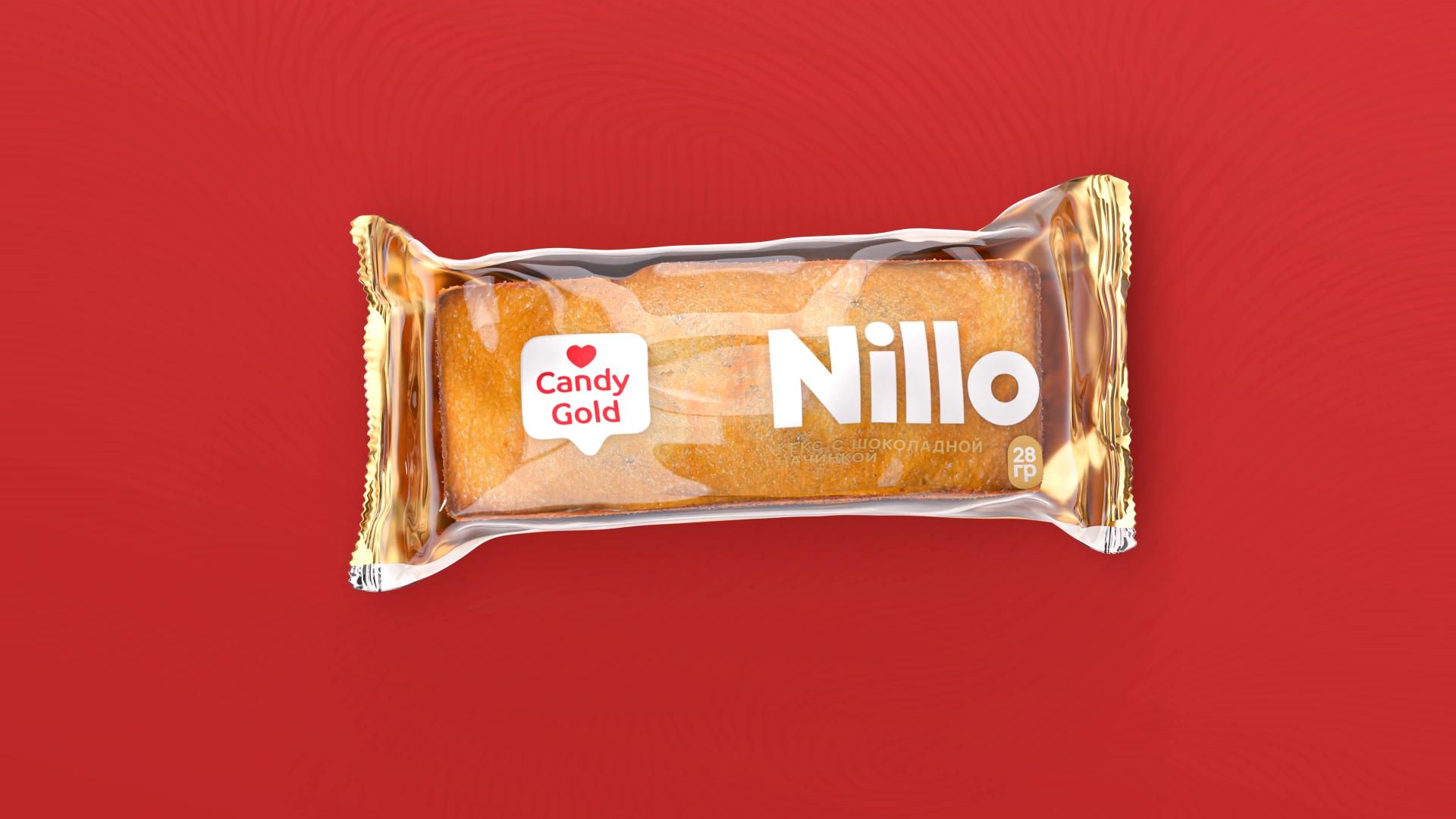
Candy Gold: test demand first. When imports of some confectionery stopped and gaps appeared on the shelves, Candy Gold decided to fill them quickly with its new Nillo cakes. It needed packaging for a fast market launch that was as simple to produce as possible. Minim proposed a minimalist transparent film that shows the sponge cake. As the case page describes, the brand was one of the first to fill the empty shelves, and once high demand was confirmed, the agency developed a full new design. The logic is the same as with a short run: test the market with a simple solution first, then invest in the big one.
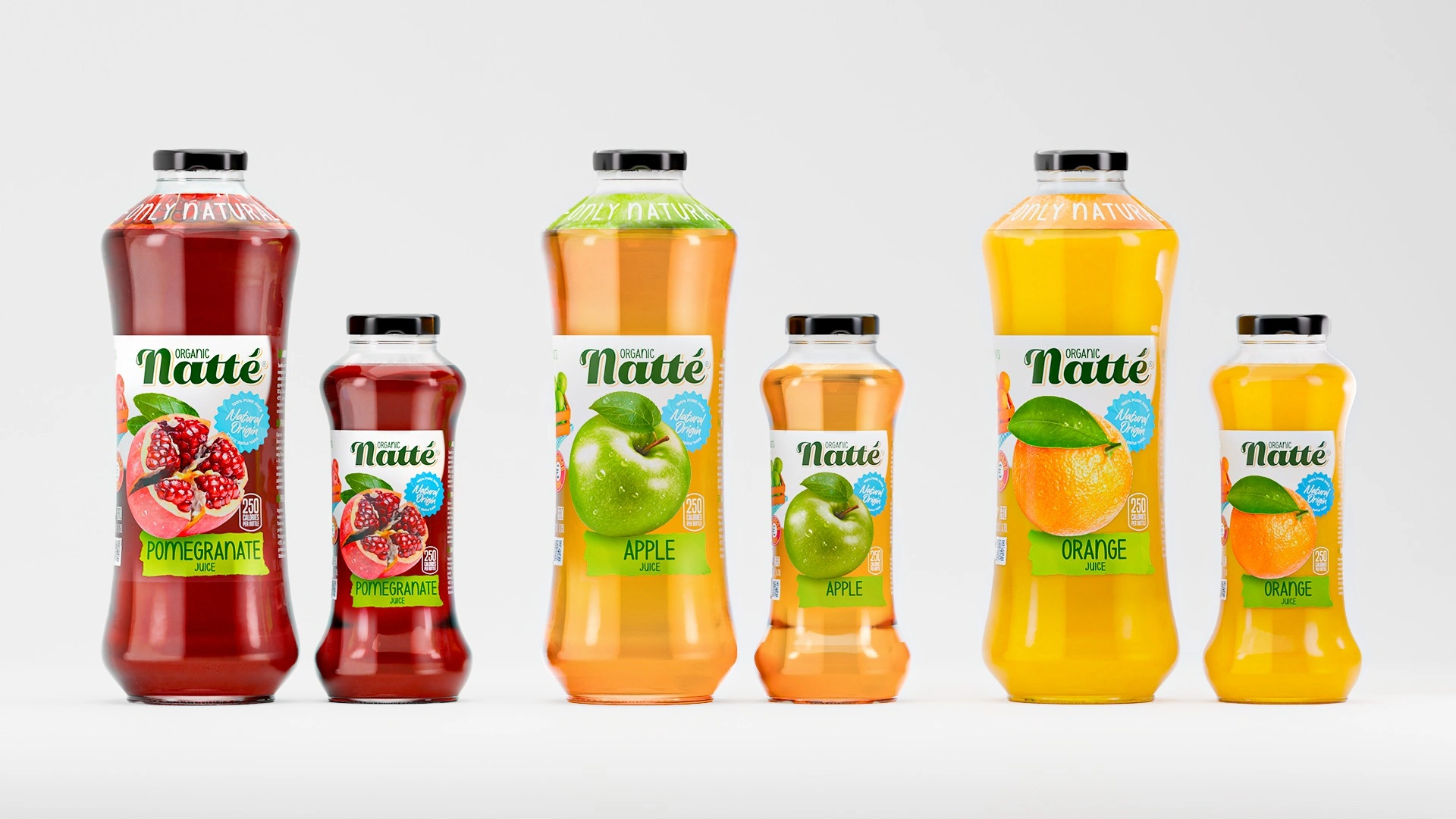
Natte: one system for eight flavours. Euro Food Trade, together with the concentrate supplier Modesto, was preparing to launch a range of natural juices in 8 flavours. Minim developed the name, logo and a label system: the flavour is conveyed by realistic fruit and a coloured band with its name; the formats are a 0.75 l bottle and a single-serve pack. When the case was published, production was still fine-tuning the technology. The common base of the label allows flavours to be printed in different run lengths by changing only the variable part, and when demand is unknown, it is convenient to calculate the run for each flavour separately.
"A print run is a sales forecast printed on cardboard. As long as there is no forecast, it is more honest to print less and pay more per unit than to print a lot cheaply and then write off the leftovers. That is why we build a common base and a variable part into the design from the start: a brand can begin with digital printing and move to offset without a redesign." — Lazizkhuja Sharipov, founder and director of Minim Design
Frequently asked questions
What counts as a short packaging run?
There is no single threshold: a run is considered short when plates and make-ready make up a noticeable share of the price. For one press it is hundreds of units, for another several thousand. So the threshold is found for a specific order: ask the printer for digital and offset quotes for several run lengths and see where the prices meet.
Why can digital printing be cheaper if each unit costs more?
Because there are no plates and no long make-ready: you pay mainly for the prints themselves. On a short run this outweighs the difference in unit price. In addition, the brand does not keep excess packaging in stock and does not risk writing it off if the recipe, weight or design changes.
Can packaging be printed digitally first and then moved to offset?
Yes, if the design was prepared for both methods: a common base, a variable part, verified brand colours and finishing without which the packaging still looks complete. Colour can differ across presses and materials, so before the first offset run you need a separate colour proof, signed off as the new standard.
Will the Uzbek alphabet reform affect packaging run lengths?
Law No. ZRU-1184 of 21 October 2026 takes effect on 22 April 2027 and replaces oʻ, gʻ, sh and ch with ö, ğ, ş and ç. The law sets no deadlines for replacing labels; the transition programme will be approved by the Cabinet of Ministers. Until the requirements are clear, it is wise not to order packaging with Uzbek text a year ahead.
How can a printer explain the benefit of a short run to a client?
Show the client the total cost of the order: two quotes — digital and offset — for several run lengths, the break-even point, storage and the write-off risk if the packaging changes. For a range with many SKUs, offer a ganged run; for a new product, a trial batch with a move to offset once demand is confirmed.
Key takeaway
The most expensive packaging is the packaging sitting in a warehouse, and the unit price in a quote does not show it. Digital printing does its own job: printing as much as the brand can confidently sell before the next change. While demand is untested, versions are many or the packaging will soon change, paying more per unit costs less than write-offs. When sales are stable and the design has settled, offset and flexo win again — with a run sized for the period in which the packaging will not change. And a design split into a common base and a variable part makes it possible to switch from one method to another without a redesign: the print run becomes not a bet a year ahead, but a decision that can be revisited.
About the author. Lazizkhuja Sharipov is the founder and director of Minim Design and has led the agency since it was founded in 2019.
About Minim Design. Minim Design is a packaging design agency from Tashkent, founded in 2019. The team has more than 20 specialists, and the agency has completed 1,156 projects and exports its services to 12 countries. Minim runs a project end to end: naming, logo, packaging design, 3D visualisation and print supervision. The agency's work has been featured by Packaging of the World, Dieline and the World Brand Design Society.
Sources
- Esko — comparison of flexography, offset and digital printing (22.09.2026): esko.com
- Smithers — The Future of Digital Print for Packaging to 2030 report (2025): smithers.com
- FTA — digital's share of printed packaging by volume and value, based on Smithers data (14.11.2025): flexography.org
- UzDaily — number of enterprises in Uzbekistan as of 1 October 2026, National Statistics Committee data (16.10.2026): uzdaily.uz
- Gov.uz — signing of the law on improving the Uzbek alphabet (21.10.2026): gov.uz
- Lex.uz — Law No. ZRU-1184 of 21.10.2026, text and effective date: lex.uz
Share

Other articles
13.11.2026
From Loose Goods to a Brand: How a Producer Moves from Wholesale to Retail
At the bazaar, rice from one sack is no different from rice in the next: shoppers compare the price per kilo and buy from whoever gives a better deal. Below: where to start, which channel to choose first, what must be on the pack, and how not to overpay for your first product line.
13.11.2026
Confectionery Packaging Design: Wafers, Sweets and Biscuits
A pack of wafers is taken off the shelf in a couple of seconds, and shoppers rarely compare ingredients. Below we look at how confectionery packaging design differs for wafers, sweets and biscuits, how to show flavour through film, when a window is needed, and how to keep a range of a dozen flavours in order.
10.11.2026
Packaging Design Development Stages: How the Minim Agency Works
Before ordering packaging design, a manufacturer wants to know three things: how long it will take, what they will see and at what point they can influence the result. And an explanation of why the result matters to us as much as it does to the client.